AI generated this summary from the Hebrew recording. No human has checked it, and it may contain errors. The recording is the authoritative source.
This episode’s guest is Tom Wegner, a strategic consultant, founder of “The Center for the Middle East,” co-founder of the “Center for Normalization in the Middle East” association, and author of the books “The Abrahamic Revolution” and “Union of the Believers.” Wegner participated in a simulation of the “Riyadh 2025 Conference” in a unique role, and he talks with Boris Gorelik about his insights from the event and his vision for regional peace based on religious and political cooperation.
Read the full episode summary
Tom Wegner’s centers and books
At the beginning of the conversation, Wegner presents his work. “The Center for the Middle East” is a platform that hosts speakers from the Muslim world every week and runs WhatsApp groups for direct dialogue between Israelis and various groups in the Middle East, such as Kurds, Iranians, and Lebanese. The “Center for Normalization in the Middle East” is a new association whose goal is to expand this activity and create direct, unmediated contact between Israeli society and friendly elements in the region.
His book, “The Abrahamic Revolution,” presents a new concept of peace born from conversations with intellectuals from the region after the events of October 7th. His second book, “Union of the Believers,” was co-authored with the Palestinian writer Elias Nasri Baboun and outlines an unconventional peace concept based on an original interpretation of the Abrahamic religions. According to Wegner, the conflict is not only territorial but also cultural and religious, so a solution is needed that also addresses these dimensions.
The potential of interfaith dialogue
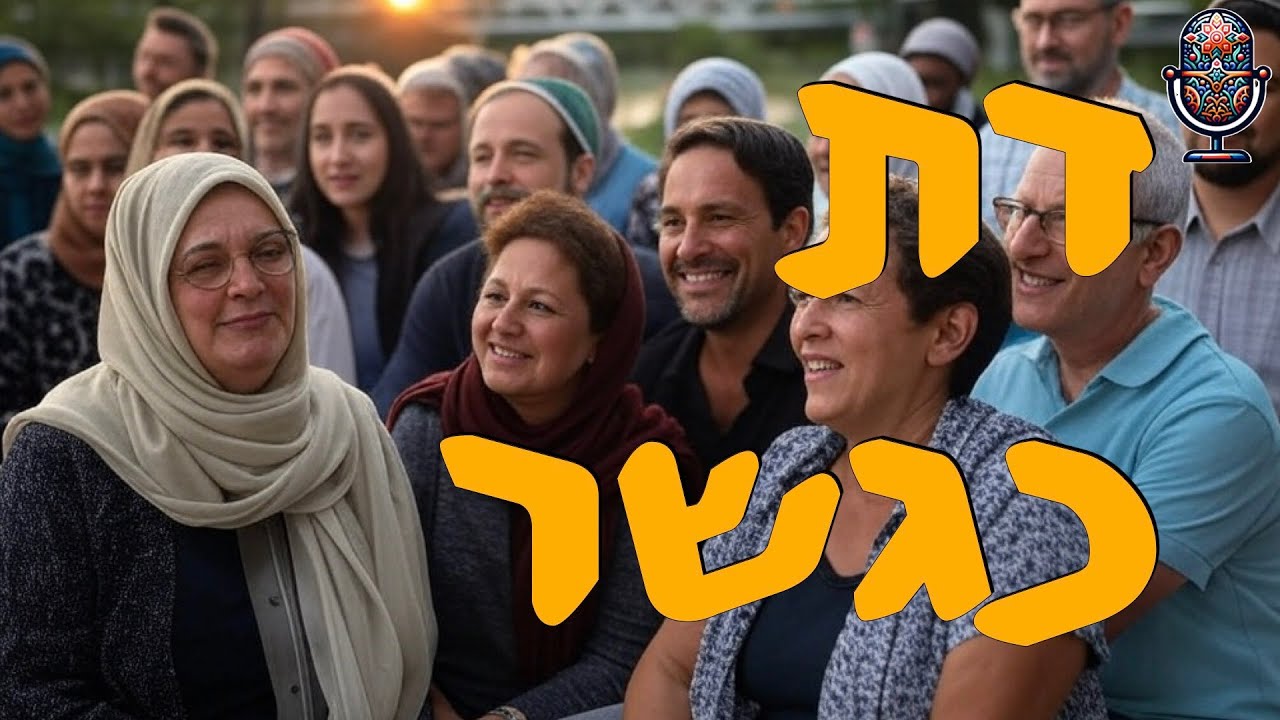
Wegner argues that dialogue between Jewish and Muslim religious figures has great potential. He tells of fruitful meetings he holds, both secretly and publicly, between rabbis and imams. According to him, contrary to the prevailing view, there are many points of convergence between Judaism and Islam, not just similarities. For example, he mentions a meeting he arranged between Rabbi Yaakov Nagen from Hasidic Judaism and Sheikh Ghassan Manasra from Sufi Islam, which demonstrated the closeness between the two streams.
He claims that when one reads the original texts of the Tanakh and the Quran, without the later interpretations, one discovers that they get along well with each other. He explains that the Quran itself calls for debating with the “People of the Book,” Jews and Christians, in a pleasant manner and emphasizes God’s attributes of mercy. The clash, in his opinion, is not between the religions themselves but between religion and tribal, violent cultures.
The Temple Mount as a test case
Boris raises the issue of the Temple Mount as an example of the difficulty, noting that the Chief Rabbinate forbids Jews from ascending the Mount and the Muslim muftis are not expected to invite them to pray. Wegner replies that the position of the Mufti of Jerusalem, who prevents Jewish prayer, contradicts the principles of the Quran, according to which a mosque is a house of prayer for all peoples, and especially for the “People of the Book.” He quotes a Syrian Sunni imam who said that preventing any person from praying is considered a grave sin in Islam, bordering on heresy. According to Wegner, Islam’s original peace plan is to invite others to the mosque to persuade them gently, not to kill them.
Wegner’s role in the simulation: Abrahamic religious leader
In the Riyadh conference simulation, Wegner played a unique role created especially for him: “Abrahamic religious leader.” He did not represent a specific religion but spoke on behalf of a collective of all monotheistic religions, an idea originating in his book “Union of the Believers.” As part of the role, he “burst into” the conference to call on politicians to make peace in the name of God.
The concept he promoted is that the differences between the Abrahamic religions in their original versions are marginal and do not justify war. He notes that the most significant theological difference between Judaism and Islam is the question of who was bound for sacrifice, Isaac or Ishmael. According to him, Hamas has distorted the religious narrative, and now major figures in the Muslim world, such as the World Council of Imams and muftis in Saudi Arabia and the UAE, are speaking out against it and distinguishing between extremist Islam and original Islam.
During the simulation, Wegner worked behind the scenes. He agreed with the Qatari delegation on a delegation of imams to visit al-Aqsa, and a reciprocal delegation of rabbis to visit Qatar. In a conversation with the Palestinian representative, Samir Sinjilawi, he suggested that the Palestinians invite Jews to pray inside the al-Aqsa Mosque to neutralize the tension. Sinjilawi was surprised and responded with a question about the more urgent need for a Palestinian state, and also cited the Chief Rabbinate’s ban on Jews ascending the Mount. Wegner noted the irony that he was speaking for Islam and the Palestinian was speaking for the rabbis.
A vision for regional union and the importance of direct contact
Wegner admits that for now, his ideas do not have a foothold among senior political leaders, but he identifies a positive trend of developing regional politics. He notes the direct engagement of Israeli politicians with the region’s countries, and vice versa. His long-term political vision is the creation of a structure like the European Union in the Middle East, with a regional parliament that would allow conflicts to be managed with political rather than military tools. He mentions that Dr. Mordechai Kedar, who played the head of the Israeli delegation in the simulation, also expressed a similar aspiration for Israel to be accepted as an equal member in a regional league.
In conclusion, Wegner emphasizes the critical importance of direct contact between Israelis and Arabs. According to him, there is greater demand for dialogue on the Arab side than on the Israeli side, and this disconnect leads to ignorance and distorted perceptions. He calls on Israelis to leave the “aquarium” of internal discourse, learn to speak with the other side, and use technological tools to overcome the language barrier.
The original episode, in Hebrew: דת כגשר