AI generated this summary from the Hebrew recording. No human has checked it, and it may contain errors. The recording is the authoritative source.
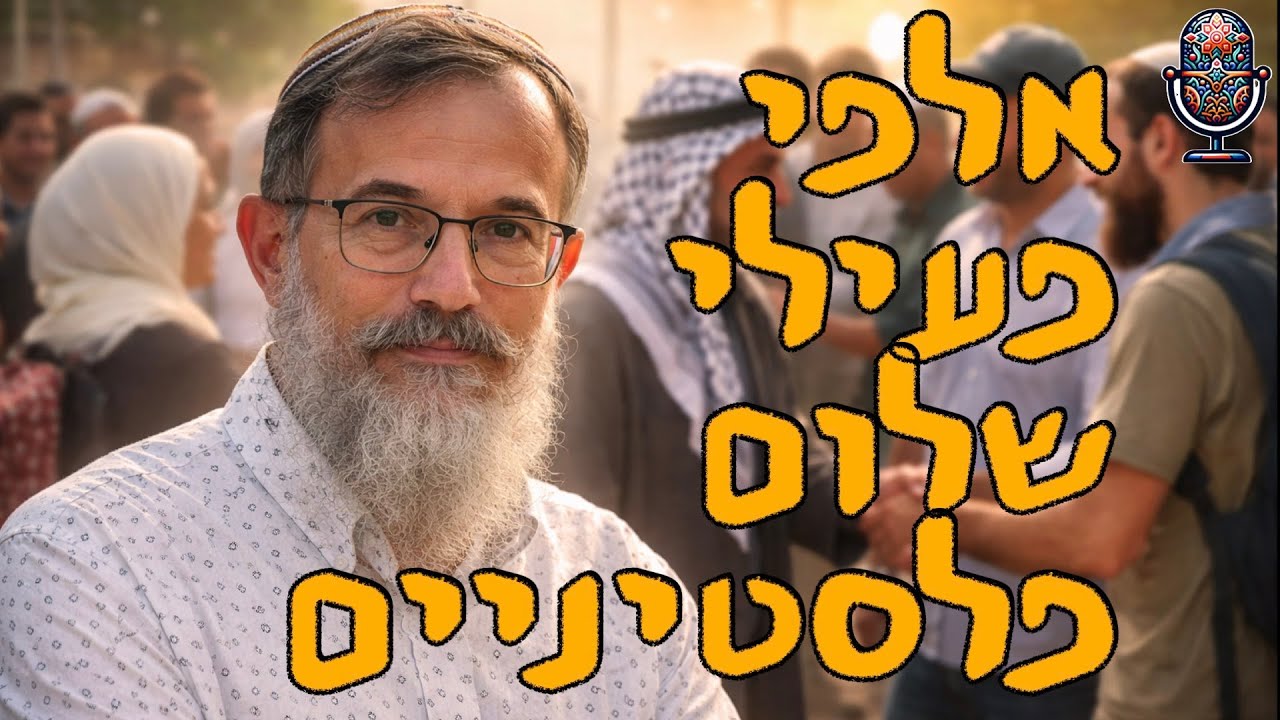
In this episode, the guest is Rabbi Hanan Schlesinger, a co-founder of the “Roots Initiative”, for a conversation about the initiative’s activities which bring together Jews and Palestinians in Judea and Samaria. Rabbi Schlesinger, a settler and resident of Alon Shvut, talks about the personal process that led him to peace activism, presents his view on the roots of the conflict, and describes the organization’s daily activities and his vision for the future.
Read the full episode summary
The Roots initiative and Rabbi Menachem Froman
Rabbi Schlesinger begins by introducing the “Roots Initiative”, which he defines as a local Jewish-Palestinian initiative for understanding, non-violence, and transformation. He emphasizes that the initiative does not “bypass the government” but rather complements what the government should be doing, namely, bottom-up work from the ground. According to him, the settlements are not just an obstacle to peace, but can also be a key, depending on how the settlers act.
The initiative was founded in 2014, partly to continue the path of the late Rabbi Menachem Froman, who was the rabbi of the settlement of Tekoa and a well-known peace activist. Rabbi Froman, Schlesinger explains, was a controversial Zionist figure who met with Palestinian leaders like Yasser Arafat and Sheikh Ahmed Yassin, out of a deep Jewish religious conviction. Most of the founders of “Roots”, both Israelis and Palestinians, were his students. The founders include Shaul Judelman, the poet Eliaz Cohen, and on the Palestinian side, members of the Abu Awwad family from the village of Beit Ummar.
The personal journey from ignorance to encounter
Rabbi Schlesinger talks about the personal process he went through. During his nearly 40 years living in Alon Shvut, he had almost no contact with Palestinians. He describes them as the “background” in the movie of his life, transparent figures who could be ignored. The turning point occurred when the penny dropped and he realized he was lying to himself when he claimed to pick up every hitchhiker, while in reality he only picked up Jews. The realization that he was not even aware he was ignoring Palestinians made him feel like a racist, and he decided to embark on a journey to get to know them and to see them as human beings.
After several failed attempts to make contact, he was invited to a meeting of Israelis and Palestinians near his home. He describes the fear that gripped him and his wife as he left the house, and the shock he experienced when he discovered a group of 15 Israelis and 15 Palestinians talking among themselves at the meeting place, a sight he was not used to. In retrospect, it turned out to be the founding meeting of “Roots”.
The root of the conflict: a struggle of identities
According to Rabbi Schlesinger, meeting Palestinians changed his life. He understood that in the Land of Israel, there is another story alongside the Jewish story, and whoever lives only one story is living a lie. He quotes his Palestinian partner, Ali Abu Awwad, who says that the path to peace is to hold “two truths in one heart”.
The root of the conflict, he claims, is a struggle of identities. The Palestinian people do not recognize the legitimacy of the Jewish identity and its connection to the land, and the Jewish people do not recognize the legitimacy of the Palestinian identity and its connection to the land. He argues that the Palestinian people are indeed a people, even if they are a new people formed partly in reaction to Zionism, and the denial of this by Israelis is the heart of the problem. Similarly, many Palestinians deny that the Jews are a people. The solution, therefore, must focus on mutual recognition of the identities and narratives of both sides.
A vision for the future: a confederation of two states
Rabbi Schlesinger presents his political vision, which is based on the plan of the “A Land for All” movement, of which he is a member. The plan, called “Two States, One Homeland”, proposes a confederation solution. According to the model, two sovereign states, Israel and Palestine, would be established, but they would be linked in a confederal superstructure, similar to the European Union. The borders would be open for free movement, and free residency would be permitted.
In such a situation, a Jew could live in Ma’ale Adumim, be an Israeli citizen (and vote in Israel’s national elections), but be a resident of the Palestinian state (and vote in its local elections). Similarly, a Palestinian could live in Tel Aviv, be a Palestinian citizen, but a resident of Israel. Such a solution, he says, recognizes the connection of both peoples to the entire land, and allows the settlers to remain in their homes.
The activities of ‘Roots’ and dealing with extremists
The activities of “Roots” include listening circles, photography and music workshops, language studies, and lectures. The goal is twofold: first, to get to know the person in front of you and not see them as a monster. Second, and more importantly, to recognize the collective identity they carry, even if it contradicts your own. In addition, the organization engages in activism against violence from both sides, including educational activities in Palestinian schools and activities among the Israeli public against “Jewish terror”.
Rabbi Schlesinger painfully admits that Jewish violence sometimes stems from a religious ideology. He does not claim that his Judaism is more “real” than that of the extremists. According to his method, many possibilities exist within Jewish sources, including a violent Judaism and a tolerant Judaism. He cannot claim that his interpretation is more authentic, only that it is more correct for the current reality. The choice, he says, is which direction to take hold of.
A small chance, a great responsibility
To the question of optimism, Rabbi Schlesinger answers that he believes there is a small chance of reaching reconciliation and peace. But precisely because a chance exists, however small, the responsibility falls on him and on everyone to act to make it a reality. If everyone acts, the small chance will become a reality.
The original episode, in Hebrew: אלפי פעילי שלום פלסטינים