AI generated this summary from the Hebrew recording. No human has checked it, and it may contain errors. The recording is the authoritative source.
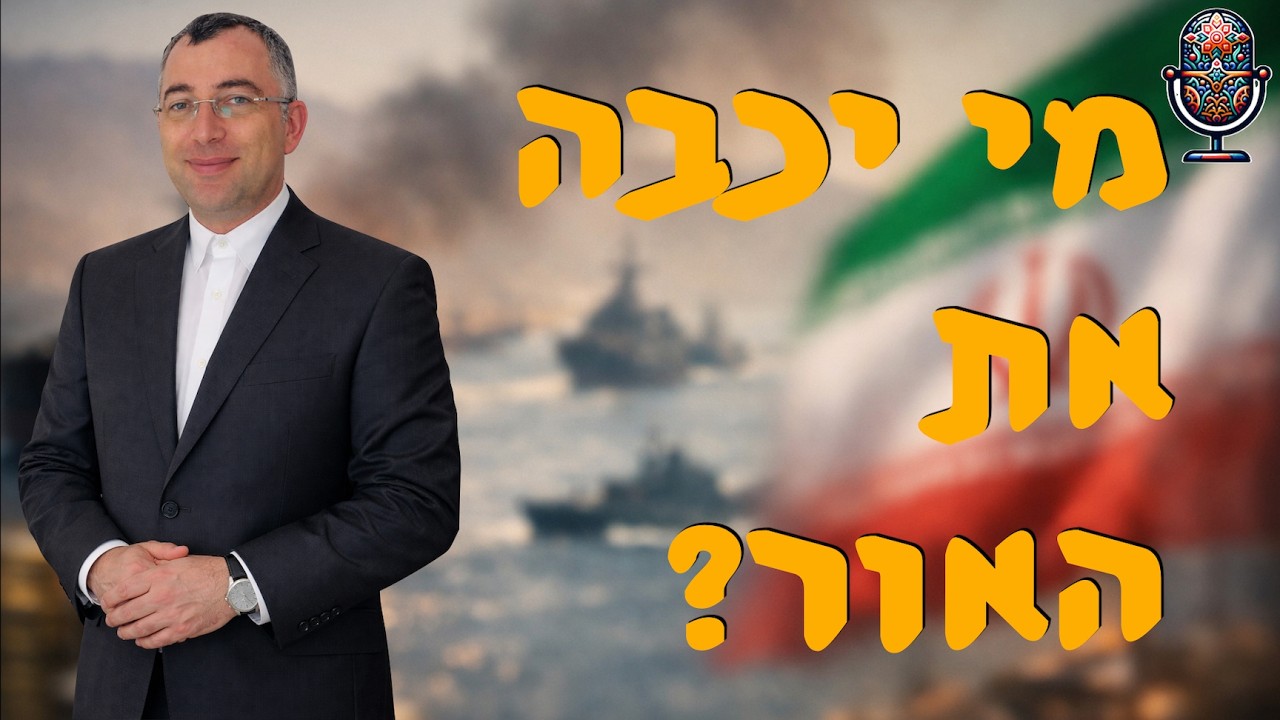
In this episode, the guest is Middle East scholar and Iran expert Alex Grinberg. The conversation deals with the campaign against Iran, the future of the Islamic regime, and the question of who will declare the end of the war. Grinberg argues that the regime is not expected to fall officially, but rather to be gradually eliminated, and that Iran is expected to remain a unified country even on the day after.
Read the full episode summary
Methodology: Understanding Iran
According to Alex Grinberg, the media narrative of the regime’s imminent fall is a misrepresentation. He emphasizes that no official, neither in Israel nor in the United States, has set the overthrow of the regime as a war objective. The stated goal is to remove the existential threat, and in the process, create conditions that will allow the Iranian people to act.
Grinberg adds that a necessary condition for understanding Iranian society and politics is knowledge of the Persian language. He compares this to a physicist, who cannot practice their field without knowing mathematics. He claims that assessments of Iranian society by experts who do not speak Persian are worthless.
Eliminating the regime, not overthrowing it
Boris Gorelik asks if the Iranian threat can be removed without overthrowing the regime, and who is expected to sign a surrender. Grinberg replies that one should not expect a formal surrender or a white flag, as happened with Nazi Germany, nor an orderly transfer of power like in Spain after Franco or in the Soviet Union. According to him, military and political terms are not mathematical formulas, but are context-dependent.
He distinguishes between “overthrowing a regime” and “eliminating a regime.” While the regime will not be officially overthrown, it will be eliminated in practice. The strategic threat, such as the ballistic missiles, has already been largely removed, and the IDF continues to hunt the few remaining launchers.
The Iranian regime as a mafia organization
To explain the logic behind eliminating the regime, Grinberg compares its conduct to that of a mafia organization. According to him, the mafia has several rules of conduct:
- It does not plan for the long term and does not prepare an alternative plan. Presenting a plan B is seen as a challenge to the leadership.
- All its members are partners in crime and mutually responsible for one another. They have nowhere to run, so they fight to the end.
- It goes for broke, and ultimately loses.
This comparison explains why the regime will not surrender, but also why it is expected to crumble under sustained pressure.
Damaging the regime’s capabilities
Grinberg describes how military activity systematically damages the regime’s capabilities for control and oppression. He notes that air force strikes focus, among other things, on stadiums used as assembly areas for the Basij and the Revolutionary Guards. Hitting these places prevents them from organizing and disperses their forces.
Additionally, he points to a phenomenon of Basij and Revolutionary Guards personnel being eliminated by small drones. Since these are short-range tools, the conclusion is that the operators are inside Iran. This indicates extensive cooperation by Iranian citizens with the attacking forces, including providing real-time coordinates of targets.
Will Iran break apart?
Boris Gorelik asks if Iran might break apart into separate ethnic states, as some commentators claim. Grinberg firmly rejects this possibility. He explains that most ethnic minorities in Iran, such as the Azeris, Kurds, and Baloch, see themselves first and foremost as Iranians. He gives the example of the Iran-Iraq War, in which the Arabs of Khuzestan province fought for Iran against Saddam Hussein’s army, and the Shiites in Iraq fought for their country against Iran.
Furthermore, neighboring countries have no interest in Iran’s breakup. Azerbaijan, for example, would not want to absorb tens of millions of Azeris from Iran, and Iraqi Kurdistan would not support the establishment of another Kurdish state.
The inability to recover
In conclusion, Grinberg argues that the Iranian regime has suffered severe blows from which it cannot recover. It has lost the support of the Arab world and Russia, it lacks the necessary resources, and it has no legitimacy or cooperation from the population. In this situation, it will not be able to restore its nuclear program or its military capabilities. Iran might become an isolated ghost state like North Korea, but it will no longer pose a strategic threat.
A question from the audience: Broadcasting impact maps
In response to a listener’s question, Grinberg recounts an incident in a television studio where he protested the display of maps of launches from Iran alongside maps of impact sites in Israel. He claims that broadcasting such information constitutes aiding the enemy, as it allows them to improve their missile accuracy. He clarifies that he did not attribute malicious intent to the presenters, but pointed out a dangerous practice that should be avoided.
The original episode, in Hebrew: מי יכבה את האור?