AI generated this summary from the Hebrew recording. No human has checked it, and it may contain errors. The recording is the authoritative source.
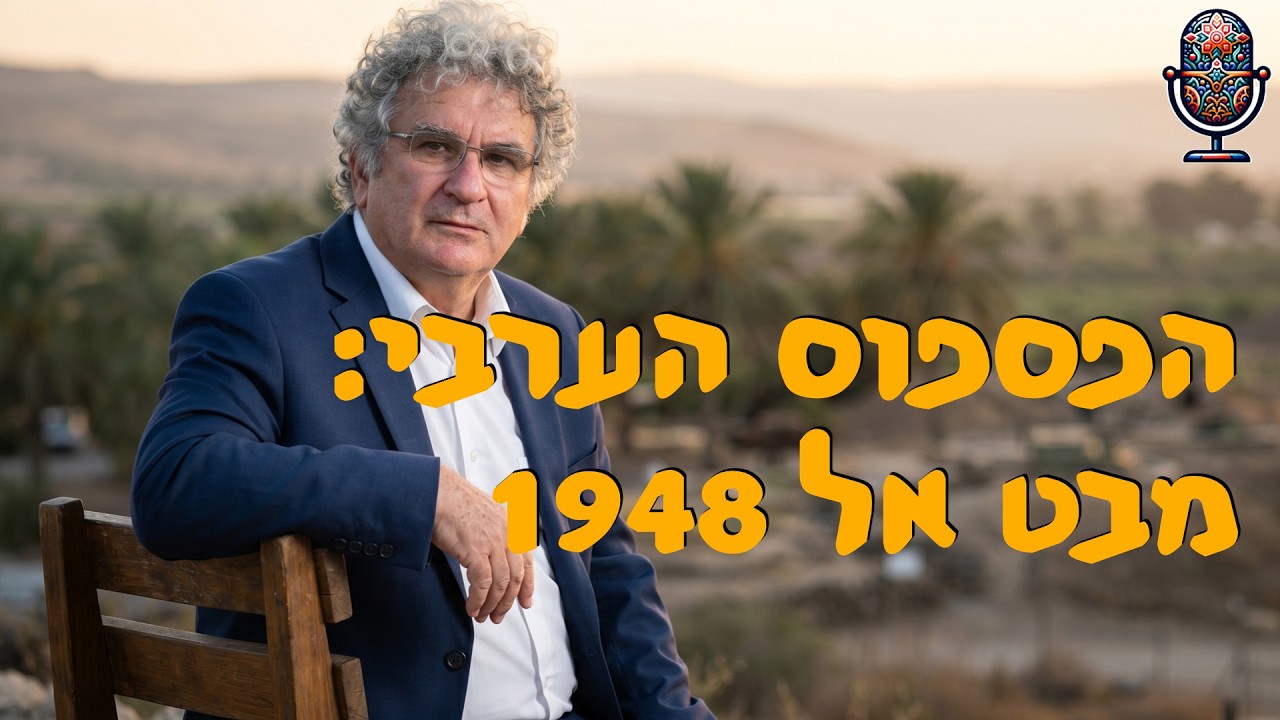
In this episode, Boris Gorelik speaks with historian Prof. Benny Morris, a professor emeritus at Ben-Gurion University. The conversation provides a historical analysis of the decisions made by the Arab leadership in Palestine in the late 1940s, examines whether they had better alternatives, and discusses the consequences of those decisions on the Israeli-Palestinian conflict to this day.
Read the full episode summary
The Arabs’ opening position in 1947
According to Prof. Benny Morris, the Arabs of Palestine entered the 1947-48 conflict with a clear demographic advantage, outnumbering the Jews two to one, and enjoyed potential support from the Arab and Muslim world. They felt self-confident. However, they did not recognize and did not want to recognize the Jewish claims to the land, and Jewish history or the Holocaust did not interest them. As early as the late 19th century, Prof. Morris explains, Arab intellectuals warned that Zionism aimed to take over the land and displace the Arabs. This fear, combined with the lack of recognition of Jewish aspirations, led them to believe that Arab and Muslim power would prevent the establishment of a Jewish state.
The development of Palestinian identity
Boris asks when the Arabs of the land began to see themselves as a separate Palestinian people. Prof. Morris believes the process began in the 1920s. According to him, it was a byproduct of geopolitical changes: the British conquest of the land and its separation from Greater Syria, which fell under French rule. The Arabs in the land understood that their political future was tied to the British and the Zionist challenge, not to what was happening in Damascus. From that moment, they began to think of themselves less as “Southern Syrians” and more as Palestinians. He emphasizes that most of the population was not political, but this national consciousness finally crystallized around 1948.
The choice of war
Prof. Morris explains that the war did not begin with a central order from the Mufti, Hajj Amin al-Husseini, but rather spontaneously, with local violent incidents that escalated into a civil war. The Arab leadership faced three options: accept the UN partition plan, accept Jewish rule, or go to war. They chose war. According to him, given their state of mind at the time, they probably could not have chosen differently. Their mindset was not built for compromise with the Jews.
The advantages of the Yishuv
The Jewish side, in contrast, enjoyed several crucial advantages. The Yishuv had succeeded in establishing a “state within a state” with functioning institutions. Additionally, it had great economic superiority, which was strengthened during the war by extensive donations from American Jewry. These funds enabled the purchase of weapons and the continuation of civilian functions. The Arab armies, except for the well-trained Jordanian Legion, lacked the resources, equipment, or training for a war beyond their borders. They were primarily designed to protect the regimes at home.
After the 1948 war
The defeat in the war left the Arab world with a sense of humiliation and a desire for revenge. At the same time, they recognized that Israel was strong. Prof. Morris notes that the establishment of the Jewish state also created a geographical disconnect between the eastern and western parts of the Arab world, which greatly bothered them. The “Three Nos” resolution at the 1967 Khartoum Summit was an expression of this humiliation, but according to him, this stance did not last long. After the 1973 war, which was perceived in the Arab world as an achievement, it was psychologically easier for leaders like Anwar Sadat to accept Israel’s existence and turn to peace.
Prospects for peace and the pessimistic future
Prof. Morris is pessimistic about the future. He argues that a true regional peace is not possible without a solution to the Palestinian problem, meaning the establishment of an independent Palestinian state. He believes this is a necessary, though not necessarily sufficient, condition for ending the conflict. According to him, Israel has rarely offered such a solution over the years, and even when it did (during the Barak and Olmert eras), the Palestinians refused. He adds another pessimistic layer: Jewish society in Israel is becoming more religious and right-wing, and support for the two-state solution is eroding. Meanwhile, Palestinian terrorism and rejectionism on the Arab side reinforce this trend. Without peace with the Palestinians, he warns, the existence of the State of Israel will ultimately be endangered.
The original episode, in Hebrew: הפספוס הערבי: מבט אל 1948