When rigid blocs break, they break together
A rigid voting bloc is supposed to be the boring case. People vote the same way, election after election, because their identity tells them to. The interesting story, the textbook says, is what happens when the bloc weakens.
I want to argue the opposite. The interesting case is when a rigid bloc breaks — and it breaks at every address at once. That synchronized fracture is not the bloc weakening. It is the bloc working.
The puzzle
Israel’s ultra-Orthodox (Haredi) population is one of the most disciplined voting blocs in any democracy. Two parties — UTJ for Ashkenazi voters, Shas for Sephardi voters — have split that vote with 90-95% loyalty for decades. Cross-ethnic voting (a Sephardi voting UTJ, or an Ashkenazi voting Shas) is so rare it is treated as measurement noise.
Then, in the March 2021 election, that noise jumped to 12-19% of Sephardi voters in five different cities, all at once. By the next election it was gone again. The voters did not move house. The borders did not shift. Same people, same streets, one election of mass cross-ethnic switching, then back to baseline.
The chart
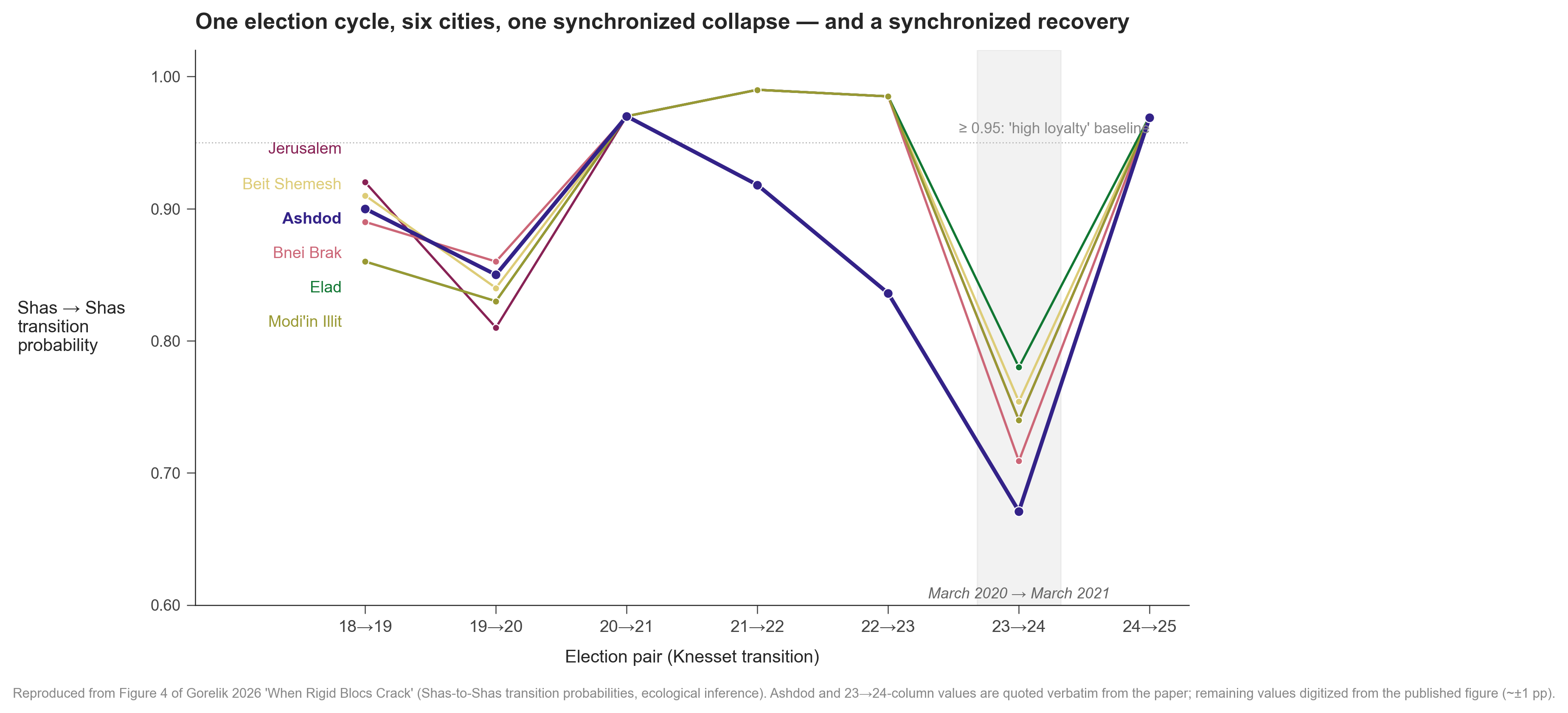
Cross-ethnic switching jumped from a typical 1-3% to 9-19% across geographically dispersed Haredi cities — within a single election cycle. Demographics cannot move that fast. Something else did.
Why this matters
There is a tempting reading: the bloc was finally weakening. Identity politics fading. Voters acting as individuals.
That reading is wrong, and the geography is what tells you so. Independent voters do not switch in five cities in the same election in the same direction. Independent voters do not return to their original party 13 months later. What you see in the chart is coordination, not autonomy.
The corpus evidence — about 58,000 Haredi forum and news items from those 13 months — points to a specific channel: senior rabbis, working through yeshiva networks, told Sephardi voters to vote UTJ that one cycle. They listened. When the directive softened, they returned.
The framework
I call this ‘rigidity with stress fractures.’ The same machinery that produces decades of unbroken loyalty — centralized authority, dense networks, voting framed as collective duty — is the machinery that produces an instant, country-wide swing when leaders ask for one. Rigidity and synchronized switching are not opposites. They are two outputs of the same system.
This generalizes. Any identity-based bloc with centralized authority, organizational reach, and a population trained to follow directives can do this. Italian Christian Democracy under bishop replacements (Lanzara et al., 2024). U.S. evangelical voter guides (Campbell et al., 2011). Ethnic broker networks across sub-Saharan Africa (Horowitz, 1985). The Haredi case is unusually clean because elections came every 6-12 months and let us watch the disruption and the recovery in the same window.
The takeaway
When you see a sudden swing inside a population that was supposed to be politically immobile, do not jump to ‘the bloc is fragmenting.’ Check first whether the swing is synchronized — same direction, same magnitude, multiple places, single window. If it is, you are not watching the bloc weaken. You are watching it obey.
The mechanism that holds the bloc together is the same one that can move it. Stability and discipline-driven volatility are not opposite diagnoses. They are the same diagnosis read at different speeds.