Rules don’t change how people write. Contrasts do.
If you want someone to write, design, or build differently, stop writing longer rules. Produce the alternative they can compare against. The contrast does the work the rule could not. A new Columbia paper gives this principle a name and the data.
What the paper found
Li et al. (2026) studied scientists trying to translate research into social media posts. Standard advice told them to use relatable examples, walkthroughs, and personal language. Most ignored it or actively resisted. Abstract rules don’t tell anyone what “personal” looks like in their own field.
The researchers tried something else. Two versions of the same explanation, side by side. One warm, one clinical. Same science, different style.
Behavior changed. Even scientists hostile to “personal language” picked it up after seeing the dry version next to the warm one. One participant said: “I never would have thought to say this.” That line became the title of the paper.
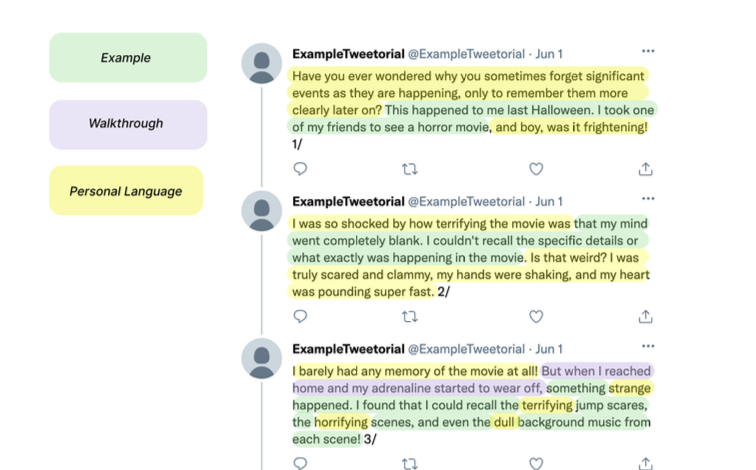
Why contrasts work and rules don’t
Recognition is cheaper than recall. Spotting which version reads better is fast. Generating a “more relatable” version from a rule is hard work. The paper invokes a basic usability principle: design for recognition, not recall. Most writing advice violates this.
Preferences are also a continuum, not a binary. There is no correct amount of personal language. People can only locate themselves on the spectrum once they see both ends.
What to do instead
When a PM tells a designer “make it cleaner,” nothing happens. When the PM produces a quick alternative mock and asks “this versus yours, what do we lose,” something happens. Same for coaching reports, editing PRDs, and prompting LLMs. “Make it better” produces hedged variants. “Here is your draft and here is a tighter version, pick which reads truer” produces change.
Style guides are rules. Diffs are contrasts. The work is in producing the alternative.