AI generated this summary from the Hebrew recording. No human has checked it, and it may contain errors. The recording is the authoritative source.
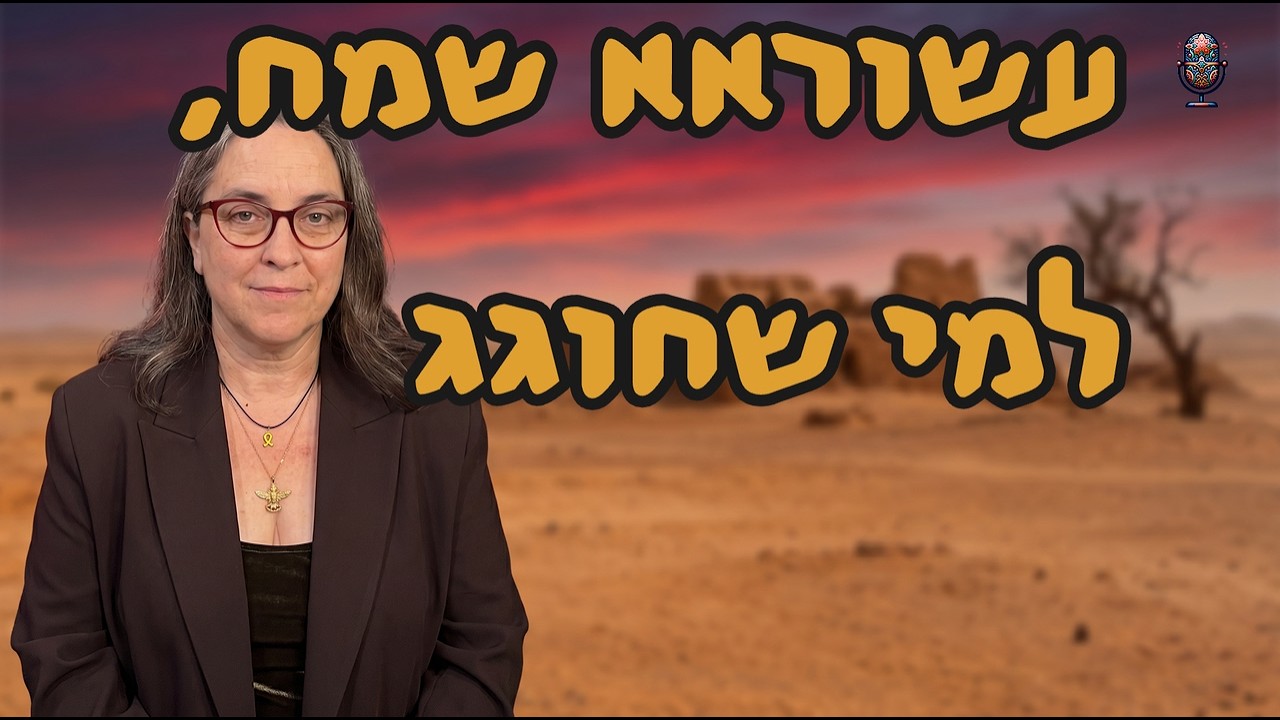
Dr. Tamar Eilam Gindin, an expert on Iran, is the guest on this episode. The conversation, recorded on the eve of Ashura, deals with the meaning of the Battle of Karbala and the death of Imam Hussein for the Shi’a. Dr. Eilam Gindin analyzes the mythological roots of the story, its influence on the mentality of the Iranian regime, and the way it is expressed in the internal rifts at the top, in negotiations with the West, and in the perception of governance and the constitution.
Read the full episode summary
The rift at the top of the Iranian leadership
According to Dr. Eilam Gindin, Ashura is particularly relevant for understanding current events in Iran. She points to the uncertainty surrounding the condition of Mojtaba Khamenei, son of the late Supreme Leader. Since the assassination attempt on his life, Mojtaba has not been seen in public, and there are conflicting reports about his condition. While sources identified with the Revolutionary Guards leak that his face was disfigured, official channels continue to publish messages in his name.
She explains that this vacuum contributes to a visible rift between the government, headed by President Pezeshkian, and the Revolutionary Guards. She provides examples of this: the president apologized to the Gulf states for rocket fire, and a few hours later the Revolutionary Guards launched another barrage. Similarly, after a memorandum of understanding was reached to open the Strait of Hormuz, the Revolutionary Guards fired at ships in the Gulf. Hardline figures like Saeed Jalili, who expresses the position of the Revolutionary Guards, have even publicly questioned whether Mojtaba is behind the decisions made in his name, and demanded audio or video proof of his consent to the negotiations.
Negotiation as surrender
Boris asks why the Iranians see the recent memorandum of understanding with the West as a humiliating concession, while in the West it is perceived as a complete Iranian surrender. Dr. Eilam Gindin explains that for the hardline faction, the very act of conducting negotiations with the murderers of the leader is a deep humiliation and a betrayal of the promise to avenge his blood.
She describes an Iranian tactic known as “goldsmith’s haggling”. In this method, one side, the Revolutionary Guards, presents an extreme position to make the other side’s position, the government, seem like a reasonable compromise, even if it is still very high. It is possible that the protests against the agreement in Iran are part of such a performance, designed to show the West the internal pressure the government is under. However, she believes the rift at the top is also real, and is based on actual friction between the two bodies.
The mythological roots of Ashura
Dr. Eilam Gindin argues that the story of the Battle of Karbala is not just a historical event, but is constructed as a mythological story. She points to similarities to ancient Iranian mythology, such as the story of Iraj, the righteous youngest son who was murdered by his jealous brothers.
According to her, the story contains universal mythological motifs: the battle takes place on the tenth day of the year, Hussein has 72 companions, a typological number, like the 72 virgins, and he embodies the idea of the god or king who sacrifices himself to save the world at the new year. She finds connections to ancient Mesopotamian myths and even to Jewish traditions like Yom Kippur, in which the High Priest would risk his life by entering the Holy of Holies.
Martyrdom as victory
The central message of the Battle of Karbala, according to Dr. Eilam Gindin, is that an honorable death is preferable to a life of humiliation and surrender. This is the ethos of Imam Hussein, who chose to die rather than submit to the corrupt Caliph Yazid. This mentality gives the Iranian regime a significant advantage in negotiations. They are not afraid to lose in the conventional sense, because martyrdom (shahada) is considered the ultimate victory. According to Shi’a belief, a martyr’s (shahid’s) sins are forgiven, his body is pure, and he joins the Hidden Imam (the Mahdi) to return with him at the end of days. This belief is expressed in official mourning announcements about members of the Revolutionary Guards, which speak of their promotion to the rank of shahid and the date of their future return.
Constitution and political maneuvers
The conversation also touches on the Iranian constitution and succession struggles. Dr. Eilam Gindin explains that when Ali Khamenei was chosen to succeed Khomeini, he did not meet the constitutional requirements, since he was not a senior ayatollah. The constitution was amended and changed to suit him, in a move led by Akbar Hashemi Rafsanjani, who wanted to place a weak figure at the head of the state whom he could manipulate.
Rafsanjani’s plan failed. He forgot that the president’s term is limited to eight years, while the Supreme Leader serves for life. Over time, Khamenei accumulated power and it became clear that the president has no real authority. The current situation, in which Mojtaba Khamenei is positioned as the successor despite not meeting the religious and political criteria, is another example of how the constitution is bent for political needs.
The original episode, in Hebrew: עשוראא שמח, למי שחוגג