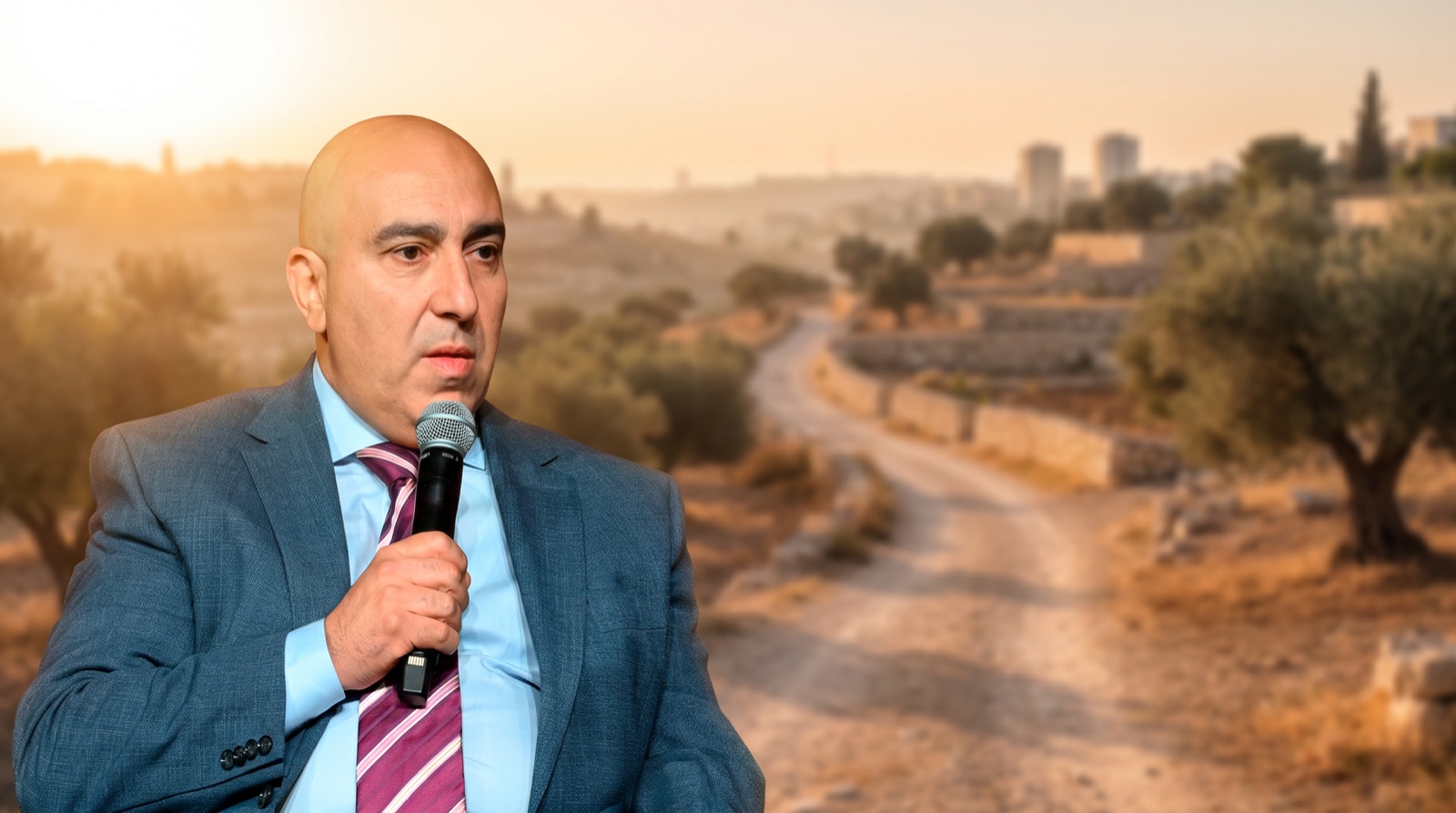
This autumn Israelis vote at the end of October, and Palestinians vote thirty-one days later. It will be the first Palestinian election in twenty years. So I invited Samer Sinijlawi back to the podcast for the third time.
Samer is a Fatah member, a Palestinian political activist, and chairman of the Jerusalem Development Fund. The first time we recorded, in March 2025, his claim was that peace is more urgent for Palestinians than for Israelis. The second time, in November 2025, he said that what October 2023 exposed was not a lack of information but a lack of imagination. This time he came with something new: he is building a party.
His thesis is one sentence long. For sixty years Palestinians tried to pressure Israel, with violence on the ground and with diplomacy abroad, and it produced nothing. The only road to a Palestinian state runs through convincing Israelis, which means putting Israel’s security at the base of Palestinian national strategy. Not as a favor to us. As Palestinian self-interest.
I should say where I stand. I am the pessimist in this conversation. Near the end I told Samer that I am for the vision he describes but that I find it hard to see it happening, because nothing good has happened here for a long time, and because building trust is a matter of years. I do not know whether he is right. I do know that talking to him leaves me less bleak than I was before, which is not the same as being convinced.
The full conversation, in Hebrew, is on YouTube: https://youtu.be/XzPBGczt4vY. What follows is translated from the Hebrew and edited lightly for clarity.
Why go to Washington, ten thousand kilometers away, or to Paris, four thousand kilometers away, when we have the Israelis five kilometers away?
Twenty years without an election
Boris Gorelik: Before we get to your party, give us a picture of how Palestinian politics actually works. The legislative council, the geographic split between Gaza and the West Bank, and what people are voting on.
Samer Sinijlawi: The Palestinian political system is closer to the French one. There is a parliament, a government, and a president, so there are two elections. There is the presidential election, and there is the election for the legislative council, which has the right to form a government and run Palestinian affairs.
Our last presidential election was in 2005. Mahmoud Abbas was elected as Fatah’s candidate, after Yasser Arafat.
Boris: Who did he run against?
Samer: Against Mustafa Barghouti, an activist from the left, if I can call it left. Abbas won 60 percent of the vote, for a four-year term. And then he cancelled the elections and continued for twenty-one years.
In parallel, in 2006, we had the election for the legislative council, our parliament, which also forms our government. Hamas won there, about 60 percent of the seats, against 40 percent for Fatah. In 2007 came the coup in Gaza, when Hamas took the territory by force. From then on we had two rulers: Hamas ruling Gaza, and Abbas ruling the West Bank. And no elections.
In 2018 Abbas dissolved the legislative council and started to be the legislating body himself. Every Palestinian law since then has come through a presidential decree. The president decides which law is enacted, what is legislated and what is not. All the power in the hands of the president. That is the West Bank. In Gaza, Hamas ruled 100 percent.
Today, after all these years, after a lot of pressure from us and also pressure from international actors who wanted a change in Palestinian politics and in the Palestinian leadership, we finally have a date. It is thirty-one days after the election on the Israeli side.
Can Gaza vote? Can Jerusalem?
Boris: Would the elections take place in the West Bank and in Gaza at the same time? And what happens with the residents of East Jerusalem?
Samer: Simultaneously, yes, that is the plan. As for Jerusalem, under the Oslo accords Palestinians there are allowed to vote. Israel has to approve that we use the Israeli post offices, people vote there, and afterwards the boxes go by mail to the Palestinian Central Elections Committee. That is how it worked in 1996, in 2005, in 2006, in every election held in the Palestinian Authority. But the recent Israeli governments have not approved the participation of Palestinians inside Jerusalem.
There is a solution. The Central Elections Committee has electronic voting, and I think we should go in that direction.
Gaza is a different set of challenges. Gaza today is not the Gaza we knew. There is almost no Gaza. There are three large populations in three different places: in the middle of Gaza City, in the center around Deir al-Balah, and in the al-Mawasi area. So maybe the committee needs to set up three election hubs, each one tied to where a large population is. There is a technical solution for running this election.
Boris: And Hamas in Gaza would allow it?
Samer: I think yes. They allowed the municipal elections to take place in Gaza in the past. And you should know that Hamas wants out of governing Gaza. It does not interest them to keep being the government there.
Why? Because they did not only lose power, they also went bankrupt. They are not paying salaries to their civil servants. They owe something like a billion dollars in debts to local banks. They simply went bankrupt. They know they cannot run this event.
There is some negotiation going on now with the peace envoy and his representatives, and the American envoys. On one side Hamas says: we can hand over the entire government right now to the national committee for administering Gaza, and we are ready to hand over the police and the security apparatus of the government, everything we received from the Authority in 2007, including the weapons of the local police. And after that succeeds, let them start disarmament, we will give them the tools to do the work. On the other side, the Israelis and the Americans say no, disarmament first. And that is where everything gets stuck.
We are also stuck in Gaza because it is an election season on the Israeli side. I do not think the political echelon wants any progress in Gaza right now. Let us see after the elections.
“I do not believe the polls”
Boris: You say Palestinians are fed up with Hamas and with Abbas. But if I am not mistaken, the pollster Dr. Khalil Shikaki shows support for Hamas, and in the West Bank even more than in Gaza.
Samer: Listen, I also follow the polls on the Israeli side. If I look at Channel 14’s polls [Channel 14 is the strongly right-wing, pro-Netanyahu channel], that gives you one picture. If I look at Channel 11, or 12, or Haaretz [11 is the public broadcaster and 12 the main commercial channel, both roughly centrist; Haaretz is the strongly left-wing newspaper], it depends who runs the poll. I do not believe these polls. I say it is a black box. You have to go to real elections, and there we will find out who has what power on the Palestinian side, whether Palestinians want change now or whether Palestinians are stuck where they used to be. And especially now, with everything going on in Gaza, I do not think you can run a poll accurately.
But I know Palestinian society a little. I say “a little” because I want to be modest. There is the Fatah bloc, Abbas’s bloc. There are 60,000 Palestinians inside the Palestinian security apparatus. There are 250,000 people employed by the Authority. That gives a lot of influence. So Abbas will still have power, maybe 25 percent. And Hamas will stay 25 percent.
Boris: Would Hamas run as a party under its own name?
Samer: They will find a solution. They will do some rebranding, they will come in through lists that look independent, and everybody will know what it is. Understand that Hamas is a political movement that has a military wing, not the other way around. For them, not participating in national elections is suicide. There is no such thing. They have to be there. They will try to build coalitions with others. I do not know what their final list will look like, but I am almost certain they will run in this election.
So there is 45 or 50 percent that is the Abbas and Hamas bloc, and there is 50 percent, maybe more, maybe 60, of voters who want something new. And there are new centers of power now presenting themselves as players in the coming election. There is Mohammed Dahlan and his stream, who have organized as a party or a list, and I think they will be a significant force. There is the New Way, the party we are building. There may be others who put up lists.
Palestinians are fed up with Hamas and with Abbas. Fed up with the destruction Hamas brought down on them in Gaza, and fed up with the corruption Abbas brought down on them in the West Bank.
Boris: If I remember correctly, the commentators back in 2006 said the public was fed up with Fatah’s corruption, and that Hamas was elected not because the public is so religious but because it did not want the Authority’s crooks. If that is true, then the chance for a party like the one you are building is high, because Fatah has not become less corrupt, and certainly Hamas has not.
Samer: Correct, although the picture is different now. In 2006 the Palestinian public had Fatah’s failed product in front of it. They saw corruption and they saw no progress. Oslo said five years of an interim agreement and after that we go to a permanent status arrangement. From 1993 to 1998 there was no progress, and we arrived at the Second Intifada. So Fatah’s product was not very convincing.
There was disappointment, and Hamas was the alternative. They also used the fact that they were victims of both sides, of the Palestinian side and of the Israeli side that fought them very hard, and they took a place in the heart and the mind of the Palestinian public. And they were smart, they picked candidates who were connected to the public. Let us say everything was working in their direction. So they rose.
Now the Palestinian public knows where Hamas led us. Gaza was erased. I do not think there will be another vote for Hamas or for Abbas. But they still hold power in the street.
What Palestinians are actually looking for
Samer: Palestinians today, Boris, get up every morning knowing that today is worse than yesterday. If there is a political force that can carry them and give them not only a vision but a practical vision, a plan that tells them there is a way for life to get a little better every morning, that answer matters. Palestinians are looking for that answer. That is where our opportunity is.
I see that inside Gaza in particular there is a desire for change. From my own activity I see how many Gazans are watching and hoping that someone can bring a force that can put things in a better order.
I have to put the security of the Israeli side at the base of every Palestinian national strategy. Not as a favor to you. To serve the national interest of my own people.
Is there a partner?
Boris: In our first conversation, in March 2025, your claim was that peace is more urgent for Palestinians than for Israelis, precisely because their situation keeps getting worse. Let me stay on the realistic side. Not that we all suddenly sit down together and start arguing about whose hummus is better. Do you still see a situation in which Israelis and Palestinians elect governments that are capable of working with each other, that do not maintain the conflict but find a way for us to say, twenty-five years from now, that the conflict has ended?
Samer: Look, the partner problem has been a serious problem in recent years. Israelis really did look for partners and did not find them on the Palestinian side. And part of the Palestinian people also lost hope that we have a partner on the Israeli side.
Everyone who says there is no partner on the other side and there never will be a partner on the other side is wrong. There is no partner now. I think there will be a partner. I am optimistic. I see a change that is almost arriving on the Israeli side. I can already imagine the next Israeli cabinet. With that next Israeli cabinet I think yes, there is a partner, not only for Palestinians, there is a partner for the whole world, and that is something Israel badly needs.
Israel has disconnected, and not only on the Palestinian question. You are also moving far away from your serious friends around the world, including Europe, including the moderate Arab states. In the last three years I have not heard of an Israeli prime minister receiving an invitation to some capital in Europe, or some capital in the Middle East. Even now such meetings are refused, in the United States too. So there is an Israeli need, an internal one, and there is an international Israeli need, for Israel to produce a different political leadership that can repair all the damage in the international theater.
A change like that also gives us, as Palestinians, options. We can look at the Israeli side and say we have an opportunity now, there is someone to talk to. But if that change on the Israeli side is not matched by a parallel change on the Palestinian side, it stays an Israeli event. The moment there is change on the Palestinian side too, it starts being a regional event, an international event, and it starts to be interesting to everybody.
The New Way: criticize ourselves, not them
Samer: That is the new thing we are bringing into Palestinian politics now. The New Way. We say the way has to change.
We focus more on where we went wrong, not on where the other side went wrong. Look at this conflict. Both sides always want to give lectures to the other side. You are wrong about this, you need to do that. But there is never internal criticism. Here we concentrate on internal criticism. We do not want to discuss their mistakes. Let them find their own mistakes, and what they fix is their business. Here we look at the mistakes we made.
For sixty years we always tried to pressure Israel by using violence on the ground and by trying to recruit the whole diplomatic world against Israel. That strategy failed. We got nothing from it.
We believe the only way that can bring good outcomes for the Palestinian side is to try to convince the Israelis, not to pressure them. Why do we need to talk to the entire world about Israelis? To go to Washington, ten thousand kilometers away, or to Paris, four thousand kilometers away, when we have the Israelis five kilometers away? So why not talk to the Israelis. It is easier for us to convince the Israelis than to convince the whole world to pressure the Israelis.
“You are strong. Do not rely on anyone.”
Boris: Especially after 7 October, people tell me: fine, Samer says nice words, but all they want is to lull us to sleep. Maybe they are right, maybe not. But that is an experiment I do not want to run on my own life again.
Samer: You do not need to run it on your life. Do not rely on anyone, Boris. You are a strong country. And make no mistake, even after 7 October you have the strongest army in the Middle East. 7 October did not happen because the Israeli army is weak. It happened because there was no Israeli army on the Gaza border that morning.
You are strong. You do not need to rely on anyone. Take care of your own security yourselves. Do not rely on a partner on the Palestinian side and do not rely on a partner on the American side.
But that does not mean you come in this direction from a position of weakness. The opposite. You demonstrated the strength you managed to demonstrate in front of the whole world, and you come to this from a position of strength. And any strength that has no diplomatic option next to it is worth nothing. The military option can buy quiet. It cannot buy peace and strategic security forever.
Israel’s security will be created only through diplomatic effort. A regional order that brings in all the new players, including the Saudis. Israel starting to be part of the Middle East, connected to everyone. And a Palestinian government that believes the basis of any successful Palestinian national strategy is the security of the Israeli side.
I have to put the security of the Israeli side at the base of every Palestinian national strategy. Not as a favor to you. To serve myself, to serve the national interest of my own people.
“We are both looking at each other from the surface”
Samer: Right now the Israeli public perceives us very badly. Why? Because the two of us look at each other from the surface, and the picture on the surface is a black picture. It is not a pretty picture. We both did bad things to each other. There is no Mother Teresa here.
But if you start looking a little deeper, we are human beings and you are human beings. Even if we are perceived by you as if everything we want is to destroy the State of Israel and not to build a Palestinian state, that is not accurate. I know both peoples well, and I say these things inside Palestinian conversations too: Israel does not want to destroy us, it does not want to throw us into the sea. Do not listen to Smotrich, do not listen to the extremists, they do not represent the Israeli public. The Israeli public wants to live in peace, in quiet, in security. If they know that a Palestinian state will supply them with security, they are ready to leave the territories and allow it to happen.
But they are not there. We have to convince them that a regional order that brings a Palestinian state next to the State of Israel can supply Israel with security. And to get there, we have to change many things.
We are not important at all. You, the Jews, are important. We were lucky that we fell into a conflict with you.
Why Egypt was the easy case
Boris: How many years, in your estimate? Not counting miracle governments, but realistic ones that move the issue forward. How many years until this is not as bad as it is now?
Samer: Let us look at a piece of history. The October of the 1970s was maybe similar to what is happening today. You had thousands of Israelis killed in October 1973. There was strong hatred in the Israeli people toward the Egyptians, and from the Egyptians toward the Israelis, and nobody thought it was possible to make peace with Egypt. And suddenly the Egyptian leader took one step, went up to the Knesset podium, and in less than an hour it changed.
But I will tell you the biggest difference. Egypt and Israel are very far from each other. So the leaders, Begin and Sadat, could sign a beautiful agreement with Carter, and the armies could put away their weapons. Here we are really close to each other. I think that today an Israeli walking into Cairo, a Jewish Israeli walking into Cairo, is better off not saying that he is Israeli and Jewish.
Here we are much too close for that model to work. Say Mohammed Dahlan and the next prime minister of Israel get up and sign some agreement. There will be balloons, they will fly. I still do not think we would be able to live in peace.
Boris: So it is not only a matter of a signature. It is a matter of deep internal change.
Samer: If a Palestinian political force rises and gets support from the street, and says we start from the base, we change the Palestinian narrative.
Rewriting the Palestinian narrative
Samer: We recognize the historical connection, the historical right of the Jewish people in this land. That is a fact, and it is a fact that is in the Qur’an. Why do we run away from it? Why do we not recognize this right? They were here. They belong here. You, the Jews, were here, and you belong here.
But look at the facts from your side as well. You were never alone here. There were always others, and the others are us. So nobody keeps rolling this conflict under the headline of either us or them. Both of us together.
And after that recognition, that same political force says: zero violence. If we want to produce good outcomes for both of us, we have to talk to them and convince them, and we will not allow violence. And there will be support from the street strong enough that all Palestinians will believe we have to resist violence, not to let violence take the lead. And then we start talking, and we tell you: both of us belong here.
We had coexistence here for thousands of years. We got tangled up in the last hundred. Let us find the shared future together, two peoples next to each other, cooperating on everything.
“We are lucky that we fell into a conflict with you”
Samer: I always ask a question of my Palestinian friends, in all the meetings we hold now for the New Way. Why are we important? Why are we, the Palestinians, important everywhere in the world?
Most of the time they do not give me the right answer. The right answer is that we are not important at all. You, the Jews, are important. We were lucky that we fell into a conflict with you. That is not a joke. It is true.
And then I start telling them: imagine now what happens if we can change this relationship from a conflict into cooperation. If we become partners and not enemies, we gain a thousand times over.
(At this point one of Samer’s children walks into the frame.)
Boris: There is a partner for you. Number nine in the family. Say hi.
Samer: I have a big family. Nine children.
The settlers are much more connected to this land and to the people than people who sit and drink espresso in cafés in Tel Aviv.
“Please, defend the whole border”
Samer: You talked about why you should trust Palestinians on security. We need to trust you. I can imagine a Palestinian state next to the State of Israel that signs some kind of military protocol in which we ask the army of Israel to protect the borders of both states together.
Why do I need to buy weapons? I do not have the ability to buy. You have them. Where would I buy them from? I need to rely on you. Please, defend the whole border. I give you, with full willingness, the right to defend the entire territory together, under agreements between the two sides, so that you hold the security of all of us together.
If we can imagine things outside the box, we will find things that make you more open, because you no longer have the Palestinian challenge, which, as you said, we live with you. And if we get rid of that challenge, all the military and intelligence capacity of the State of Israel focuses on the real enemy of both of us, the one sitting in Tehran and in other places. We move out of the frame of an Israeli-Palestinian conflict into the frame of a conflict between the moderates and the extremists in the Middle East, with both of us on the side of the moderates, dealing with the challenges that come from the extreme sides.
It is possible. But first we need a leadership on our side that can reach the Israeli side, that can talk to the hearts and minds of Israelis, that can build trust, top down. Every Palestinian prime minister has to work hard to make the Israeli prime minister his best friend. Out of that kind of relationship, out of that friendship and that trust, we can build a system of trust between the two sides, in all the institutions of both sides, between the two peoples, and in the media of both sides.
What Israelis see, and what Palestinians see
Samer: I know it is hard for you now to look at the Palestinian side in a positive way. Two days ago I saw a report on Channel 11 about Gaza, by a correspondent who is also a friend, someone I know and respect. Ten, twelve minutes, and it only talked about Hamas in Gaza. But there are many other things in Gaza. There are families. There are people. There is a kind of hard life that the Israeli public also needs to know about, not only the security challenges.
And we, as Palestinians, must not go on looking at Israel only in a negative way. There are many positive things on the Israeli side that we have to explain to the Palestinian people through the media.
Where I did not expect the opening to come from
Boris: I get infected by your optimism. On the other hand, I am for the vision you are describing, but I find it hard to see it happening, because honestly nothing good has happened here for a long time. If it does happen, I will be very glad. But the vision you talk about, building trust, is a matter of years.
I read a book a while ago by Josef Avesar, an Israeli-born lawyer in California who works on divorce cases and who has a plan for solving the Israeli-Palestinian conflict, the Israeli Palestinian Confederation. His point is that when couples divorce, the real estate, which here is the territory, is usually the least important thing. There is far more insult, far more emotional damage, and his solution deals with all of that before it deals with the real estate. It is generations of work. But something has to be done, because the state we are in now is not good.
Samer: Certainly. Look, last week I had an experience. For the first time I met part of the leadership of the far right, let us say the Religious Zionism movement, people who live in the settlements. I was always afraid to talk to that part of Israel. I did not believe anything would come out of it.
Last week I found out that I was wrong. I think the chance that peace comes from there is bigger, because the settlers, the residents of Judea and Samaria, are much more connected to this land and to the people than people who sit and drink espresso in cafés in Tel Aviv. And there I found common ground. There I found shared people. There I found that religion does not push us apart, that religion can bring us closer, that there are many similar things on both sides. That is exactly where we have to focus, on the groups that could be spoilers. If we start talking there with an open heart and an open mind, we can move forward.
A smarter two-state solution
Samer: I talked about our shared right in this land. To be more precise, the historical connection of the Jewish people to this land was more in Judea and Samaria, in the West Bank. The Palestinian collective memory of this land is more the Gaza coast, Ashdod, Ashkelon, Haifa, Acre. The two-state solution gives you the coast and gives us Judea and Samaria.
But there is nothing to be done, this is demography. We are here, you are there. Any two-state solution has to be a smart solution that does not cut anybody off.
I sometimes ask myself why we should be demanding that the settlements be dismantled. Maybe we should be asking that they stay. Israel has 20 percent Arab citizens. The State of Palestine will keep 20 percent of the Jews who live there. But we are the state that serves their security. They live under Palestinian law, we respect them, we give them guarantees, we make sure everything is fine and in order for them, so that they live here, go to work in Tel Aviv in the morning, and come home to Hebron and to Beit El. Why do we need to dismantle the settlements? So maybe we should look for a smart model of two states. Anyone who does not feel like staying inside a Palestinian state and wants to leave, leaves voluntarily. Everyone who wants to stay in any case, stays.
We have to respect that symbolic connection, that poetic connection, that each one has to this land. And also respect that you need to live in your Jewish state, and we need to live in our national state, with dignity, and with very strong cooperation on everything.
The last word
Boris: If that happens I will certainly be glad, and I very much hope we go in that direction, because the direction you are drawing is really good. I want to live in a world like that, where we live together in peace and nobody is cutting off anybody’s hands, and then we can start really arguing about hummus and about food.
Until then, thank you very much. I think that two or three months after both election cycles I will bother you again and ask for your time, and we will analyze what happened and whether we are closer to your beautiful vision or actually further away from it.
Samer: Agreed.
The full episode, in Hebrew, is here: https://youtu.be/XzPBGczt4vY. The previous conversation with Samer is here.