AI generated this summary from the Hebrew recording. No human has checked it, and it may contain errors. The recording is the authoritative source.
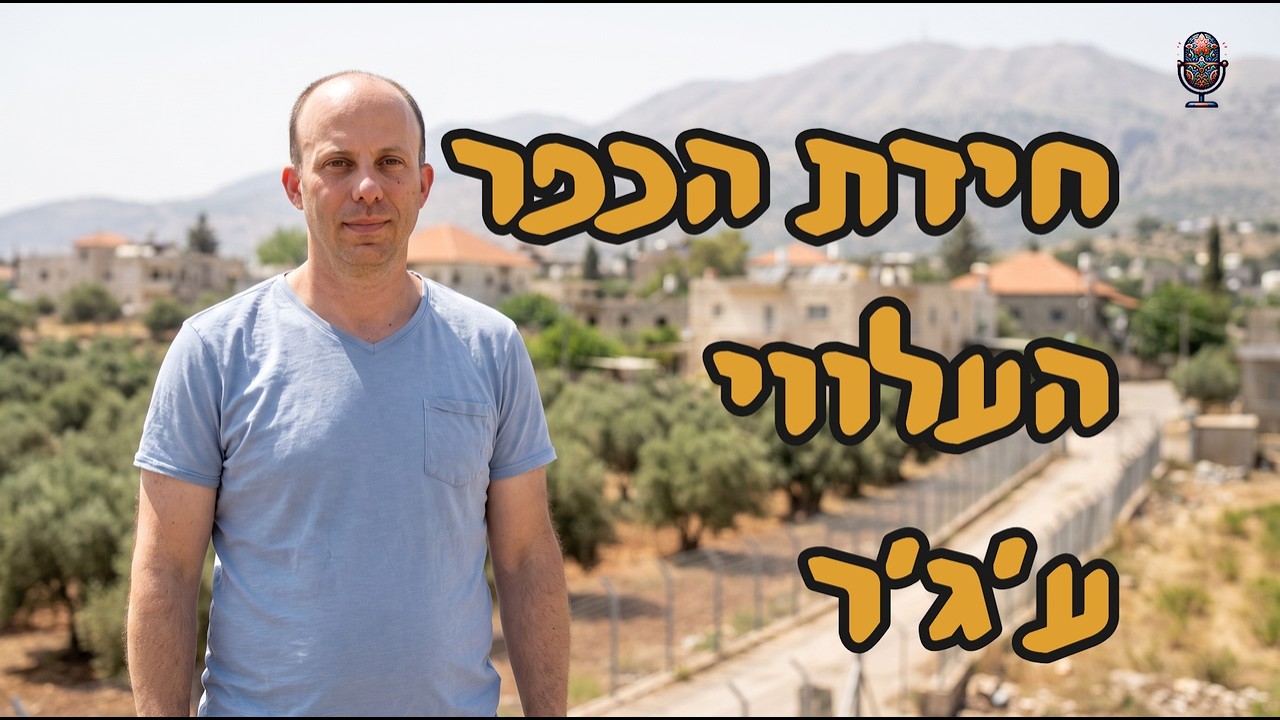
In this episode, Dr. Yaron Friedman of the University of Haifa joins the podcast to discuss the history and identity of the Alawite village of Ghajar. Following a tour of the village, Dr. Friedman attempts to solve the riddle of its origins, as it constitutes an isolated island of Alawite settlement, some 150 kilometers south of the string of Alawite communities on the Syrian coast.
Read the full episode summary
The riddle of its origins: An ancient settlement or refugees from persecution?
According to Dr. Friedman, the villagers themselves do not know for certain where they came from. Local tradition speaks of a migration from northern Syria in the 16th or 17th centuries, but there is no clear documentation for this. Dr. Friedman presents two main theses regarding the village’s origins.
The first thesis posits that an Alawite community, then called “Nusayri”, already existed in the Galilee region in the Middle Ages. In the 11th century, under the rule of Shiite dynasties, Alawite communities flourished in Greater Syria, including in Tiberias and the Galilee. One of the community’s prominent leaders, Maymun al-Tabarani, was active in Tiberias. However, there is a huge gap of about 600 years, from the 11th to the 18th century, during which there are almost no sources documenting Alawites in the area. It is possible that historians and travelers did not distinguish them from other Shiite communities in the Jabal Amel region of southern Lebanon.
Two traditions and a Syrian Arabic dialect
Dr. Friedman refers to a book by villagers Jamal and Ahmed Khatib, which documented oral traditions. The book presents two seemingly contradictory versions. One version claims the village was founded in the 11th century by the Shiite ruler Sayf al-Dawla to protect caravans. The second version links the village’s establishment to an escape from Ottoman persecution in the 16th century.
Dr. Friedman proposes a thesis that combines the two traditions. It is possible that a small, ancient Alawite settlement from the Middle Ages did exist on the site, and during the Ottoman period, a larger group of migrants arrived, fleeing economic and religious persecution in northern Syria. This would explain how the two traditions were preserved side by side.
Dr. Friedman finds support for the residents’ Syrian origin in the Arabic dialect spoken in the village. According to him, it is a distinct Syrian Arabic, similar to that of Damascus, and not Lebanese. However, it has features that are not typical of most Alawites in Syria, which could indicate local linguistic development and influence from their Shiite neighbors in Lebanon.
Three villages that became one
Dr. Friedman explains that Ghajar was not an isolated village. Until 1967, there were three Alawite villages in the area: Ghajar, Ein Fit, and Za’ura. Their residents were Syrian citizens and served in the Syrian army. In the Six-Day War, the IDF destroyed Ein Fit and Za’ura, and their inhabitants fled to Syria.
Between Syria, Lebanon, and Israel
Ghajar’s fate was more complex. After its capture in 1967, Israel withdrew from it under the mistaken belief that it belonged to Lebanon. The Lebanese army, for its part, believed the village was Syrian and also withdrew. For several months, the residents were left without sovereignty, electricity, or services. After the Lebanese government refused to accept them, they turned to Israel and asked to be annexed as part of the Golan Heights. In 1981, with the passage of the Golan Heights Law, the residents of Ghajar received Israeli identity cards.
The problems did not end there. After the IDF’s withdrawal from Lebanon in 2000, the UN drew the “Blue Line,” which ran through the heart of the village and divided houses between Israel and Lebanon, based on maps that Dr. Friedman says were incorrect. The absurd situation sparked protests from the residents. Since the outbreak of the Syrian civil war in 2011, Israel has unified the village with a fence, and the situation has stabilized to the residents’ satisfaction. Since 2022, restrictions on the entry of Israelis have been lifted, and the village has been experiencing a tourism boom.
Challenges and open questions
In conclusion, Dr. Friedman notes several open issues. First, the small and closed community of about 3,000 people faces a problem of intra-family marriage, although recently there have been a few isolated cases of marriage to non-Alawite partners. Second, the origin of the name “Ghajar,” which means “gypsies” in Arabic, is unclear. According to local tradition, it is a derogatory nickname given to them by a Kurdish landowner in the 19th century. Finally, he argues that the Lebanese government’s pressure to recognize the northern part of the village as Lebanese territory stems from the demands of Hezbollah, which is trying to take control of an area that was historically Syrian.
The original episode, in Hebrew: חידת הכפר העלווי ע׳ג׳ר