• The 'not ready to share' antipattern

    The 'not ready to share' antipattern

    May 31, 2026

    The ‘not ready to share’ antipattern

    My friend and mentor Danny Lieberman writes an excellent newsletter about antipatterns: the moves people make instinctively that quietly cost them. This post is in that spirit. The antipattern: keeping important work to yourself until it is ready. The fix turns out to be the thing the old saying tells you not to do.

    When is your work actually ready to share?

    The instinct is universal. When people work on something they consider important and big, they retreat into a shell and wait for the work to be done before they show it to anyone. A report for leadership. A presentation. A new product. A Python module. A pitch deck. The instinct is the same: I will share when it is ready.

    There is a saying in many languages: do not show half-done work to a donkey. It sounds like discipline. I think it is one of the more harmful rules people carry around. It tells you to optimize for not looking foolish today, while saying nothing about whether your final product will be any good.

    The 'not ready to share' antipattern

    A donkey, the audience the saying tells you to fear.

    “Show me your work”

    This is the trap the donkey saying sets. It tells you the audience is the problem. Show your work only to people who can already see what you see. Otherwise they will misread, miss the point, ask a question whose answer is on page two. They will. Good. The “donkey” from the saying, the reader you were told to hide rough work from, is the most useful reader you have. They cannot see the picture you carry in your head, which means they will show you where it fails outside it.

    What sharing rough work actually gets you

    If the legal or IP situation allows, share your work long before you think it is ready. The half-done draft. The rough plot. The function that almost compiles. The demo with three broken screens.

    Most of the feedback will be off-target. You will think, this person did not get it. Sometimes they did not. More often, they got something you stopped noticing: that the framing was not clear, that the order of the argument was confusing, that the assumption you treated as obvious is not obvious to anyone else. You think you know what you know, but you might not know what you know.

    The embarrassment cost of sharing rough work is small and one-time. The cost of polishing the wrong thing is large and compounds.

    So pick the piece of work you have been keeping in your shell because it is “not ready to share yet.” Find one person who will give you an honest reaction. Send it to them today, in the state it is in, with one sentence:

    “I am still working on this and I do not know what it will be. Tell me what you see.”

    You will get back something useful, often only one sentence. That sentence is worth more than another week alone with the draft.

    If you are in academia and work on a paper, publish a draft on arXiv or preprints.org. You will timestamp your findings so nobody scoops you, and you will attract feedback that makes the review process smoother.

    May 31, 2026 - 3 minute read -
    antipatterns.md shipping.md feedback tunnel-vision.md preprints.md blog
  • The UAE: From normalization to a focus of criticism

    The UAE: From normalization to a focus of criticism

    May 28, 2026

    AI generated this summary from the Hebrew recording. No human has checked it, and it may contain errors. The recording is the authoritative source.

    In this episode of “This Week in the Middle East,” the guest is Mor Shapiro, a lecturer in the Arabic department at Bar-Ilan University and a researcher at the MEMRI institute. The conversation covers the dramatic change in the status of the United Arab Emirates, which has transformed from a neutral, business-oriented country into a central and controversial geopolitical player, drawing sharp criticism from Iran and most Arab states.

    Read the full episode summary

    From a “both/and” policy to an assertive geopolitical player

    According to Mor Shapiro, the United Arab Emirates has abandoned the “both/and” policy that characterized it and the other Gulf states for years. In the past, these countries tried to maintain good relations with all sides: with the axis of resistance and political Islam, as well as with the West, while promoting their economy and trade. Today, Shapiro explains, the UAE is taking a clear and unequivocal stance, thereby becoming the most controversial player in the Middle East.

    The criticism against it stems not only from its normalization with Israel, which is now seen as “old news”, but mainly from its actions in other arenas: its involvement in the civil wars in Sudan and Yemen (where it joined forces with Saudi Arabia against the Houthis), and its determined war on what it calls “Islamic terrorism”. The UAE presents itself as an alternative and a new major player in the Arab world, a move that Saudi Arabia, which sees itself as the region’s leader, does not like.

    A rift with Saudi Arabia

    One of the clearest expressions of the tension between the countries is the UAE’s withdrawal from OPEC. According to Shapiro, although energy experts might see this as a minor drama, in the realm of inter-Arab relations it is an unprecedented act of defiance against Saudi Arabia, the organization’s leader. The move is seen as a demonstration of independence, especially regarding its policy toward Iran. While Saudi Arabia is pursuing an American-brokered agreement with Tehran, the UAE, which has suffered Iranian attacks, demands a tougher line.

    Shapiro explains that leaving OPEC allows the UAE to flood the market with oil, lower prices, and thus directly harm Saudi Arabia’s economic plans, such as “Vision 2030”. The move is perceived as a betrayal, especially after the close cooperation between the two countries in the war in Yemen and the boycott of Qatar. Shapiro adds that there is also a personal dimension, as the Saudi Crown Prince, Mohammed bin Salman, was once a protégé of the UAE’s ruler, Mohammed bin Zayed.

    “The Eastern Israel”

    The main reason for the hostility toward the UAE, Shapiro argues, is its normalization with Israel. She quotes the Palestinian academic Azzam Tamimi, who claims that the UAE has always aspired to be an ally of Israel, and that the Arab world and Iran believe it has collaborated with Israel and the United States in the war against Iran. The former president of Tunisia, Moncef Marzouki, even called the UAE “the Eastern Israel whose capital is Abu Dhabi,” and claimed it is a tool in Israel’s hands.

    Threats also come from Iran. An Iranian member of parliament stated that after the United States withdraws from the region, Iran will “put the UAE through hell”. Iranian officials often mock the UAE’s tiny size, claiming they could return it to the era when its inhabitants rode camels.

    Acquiring strategic assets

    Shapiro describes how the UAE uses its economic power not just for donations, but to acquire strategic national assets in other countries to establish its political influence.

    • Egypt: The UAE saved the Egyptian economy from collapse through a massive deal to develop a coastal strip near Alexandria. This investment, along with acquiring holdings in companies, banks, and ports, has given Abu Dhabi enormous leverage over Cairo, and it is one of the reasons Egypt refrains from sharp public criticism of Israel.
    • Jordan: The UAE is financing the “water for electricity” deal between Israel and Jordan. Jordan’s dependence on Emirati funds prevents King Abdullah from taking steps against the peace agreement with Israel or against the UAE’s normalization moves.
    • Sudan: The UAE has signed agreements to build and operate new ports on Sudan’s Red Sea coast, thereby securing control over a vital international shipping lane.

    Military intervention and Palestinian ingratitude

    Contrary to its past image, the UAE has become militarily involved in regional conflicts. It has used American mercenaries in Yemen, and it actively supports the Rapid Support Forces (RSF) in the Sudanese civil war, which led the Sudanese government to file a genocide complaint against it at the International Court of Justice in The Hague.

    Meanwhile, the Palestinian street, which previously benefited from extensive economic aid from the UAE, now sees it as a traitor. In Gaza, they burn pictures of Mohammed bin Zayed, and humanitarian aid from the UAE is seen as a “Trojan horse” intended to promote Hamas’s enemy, Mohammed Dahlan, who lives in Abu Dhabi and serves as an advisor to bin Zayed.


    The original episode, in Hebrew: האמירויות על הכוונת

    May 28, 2026 - 4 minute read -
    podcast Middle East blog This Week in the Middle East
  • The Iran-Iraq War: Why did Saddam Hussein start the war?

    The Iran-Iraq War: Why did Saddam Hussein start the war?

    May 21, 2026

    AI generated this summary from the Hebrew recording. No human has checked it, and it may contain errors. The recording is the authoritative source.

    In this episode of “This Week in the Middle East,” Professor Amatzia Baram, an expert on Iraq, joins the show to discuss the reasons that led to the outbreak of the Iran-Iraq War in 1980. According to Baram, it was a “strange war”: an initiative by one country, Iraq, to attack a country three times its size, Iran, which was in the midst of a vibrant Islamic revolution. Baram explains the chain of events and motives that led Saddam Hussein to make this risky decision.

    Read the full episode summary

    The beginning of the conflict: The Ba’ath Party and the Shiites

    To understand the roots of the war, Baram argues, one must go back to 1968, with the rise of the Ba’ath Party to power in Iraq. Its rise immediately created tension with the Shiite population, which constituted a majority in the country, for several reasons. First, the Ba’ath was an extremely secular party, with atheistic foundations. Its spiritual founder, Michel Aflaq, was a Christian. This secularism was hard for the traditional Shiite public to digest.

    Second, Saddam Hussein, who was the strongman of the regime, was paranoid and ruled with an iron fist. He infiltrated intelligence agents into the madrasas (religious schools) in the Shiite holy cities of Najaf and Karbala and tightened control over them, which caused great anger.

    The third reason was the Ba’ath’s pan-Arab ideology. The Shiites in Iraq, although Arabic speakers, constitute a majority of about 55 percent of the country. However, in a unified pan-Arab state, they would have become a negligible minority of just a few percent within a Sunni Arab world. Therefore, most of them opposed the idea.

    The Algiers Agreement and the Shiite opposition

    The tension with the Shiites worsened following the intervention of the Iranian Shah. In 1969, the Shah unilaterally canceled the 1936 border agreement concerning the Shatt al-Arab waterway, which was vital for Iraq, and began to undermine the Ba’ath regime through agents who instigated Shiite rebellions. The regime brutally suppressed the rebellions and deported tens of thousands of Shiites to Iran.

    In 1975, a surprising turn of events occurred. Saddam Hussein and the Shah signed the “Algiers Agreement,” which resolved the border dispute. In return, the Shah ceased his support for the Kurdish rebels in Iraq and stopped his subversion among the Shiites. However, according to Baram, the Shiite movement against the Ba’ath had already gained its own momentum. The internal opposition was led by a charismatic cleric, Muhammad Baqir al-Sadr, and his party, “Hizb al-Da’wa al-Islamiyya.” In 1977, massive demonstrations broke out again and were suppressed. In response, the Ba’ath regime officially declared that the Sharia (Islamic law) was null and void, a step perceived as a grave provocation.

    The rise of Khomeini and his personal score with Saddam

    The Islamic Revolution in Iran in February 1979 changed everything. Its leader, Ayatollah Khomeini, had a personal score to settle with Saddam Hussein. Khomeini had been living in exile in the Iraqi city of Najaf since the 1960s. As long as Saddam was the Shah’s enemy, Khomeini indirectly supported him. However, the Algiers Agreement made Saddam a friend of the Shah, Khomeini’s bitter enemy.

    Worse still, in 1978, at the Shah’s request, Saddam expelled Khomeini from Iraq. Baram explains that this was a stinging insult in Arab tradition, but ironically, the expulsion served Khomeini’s interests. He went to Paris, where he gained global media exposure that allowed him to manage the revolution from afar, free from the surveillance of Iraqi intelligence.

    After rising to power, Khomeini became an existential threat to Saddam’s regime. He was a personal enemy, a fundamentalist religious leader versus a secular ruler, and a Shiite leader who called for liberating the Shiite holy sites from Sunni rule. Khomeini also canceled the Algiers Agreement, thereby threatening to choke Iraq’s only sea outlet.

    The decision to go to war

    Baram describes a secret recording of a meeting of the Iraqi leadership from September 15, 1980, in which Saddam presented his reasons for going to war. He had four main reasons. The first was the internal problem, meaning the Shiite threat, which was only mentioned implicitly. The second was the strategic threat to the Shatt al-Arab waterway. The third was the desire to humiliate Khomeini, “to rub his face in the mud,” and to prove to the Shiites that their leader was weak.

    The fourth reason, and perhaps the decisive one, was the assessment that Iran’s army was dismantled. Khomeini had purged the regular army he inherited from the Shah, and Saddam believed his own strong and well-equipped army would easily win the war. Baram notes that Israeli intelligence also assessed at the time that Saddam was planning an attack, but mistakenly thought the target was Israel.

    Another catalyst for the decision was an assassination attempt by the “Dawa” party against the Iraqi foreign minister, Tariq Aziz, in April 1980. In response, Saddam executed the leader of “Dawa,” Muhammad Baqir al-Sadr. Khomeini reacted with a public call to the Iraqi people to overthrow Saddam’s regime. From Saddam’s perspective, there was no choice but to launch a preemptive strike.

    The eve of the invasion: Miscalculations

    According to Baram, both sides miscalculated. Saddam and his leadership, with few exceptions, were confident of a quick victory. Even his minister of defense, who was a professional, was forced to answer in the affirmative when asked if the army could win.

    On the Iranian side, army commanders asked Khomeini for permission to retreat to the Zagros Mountains to reorganize the army, but he flatly refused. He promised to send the young “Revolutionary Guards,” who he claimed would fight “like lions.” Baram concludes that the Iraqi attack, which was intended to exploit the division in Iran, achieved the opposite result: it united the divided Iranian people behind Khomeini, and the opposition to him almost completely disappeared.


    The original episode, in Hebrew: המלחמה המשונה

    May 21, 2026 - 5 minute read -
    podcast Middle East blog This Week in the Middle East
  • When your LLM pipeline silently returns zero

    When your LLM pipeline silently returns zero

    May 18, 2026

    When your LLM pipeline silently returns zero

    When your LLM pipeline silently returns zero

    One Sunday morning the daily scan ran for a user of Loud Camel, a tool that helps academics promote their research and get cited. It came back clean: a couple dozen items scored, zero relevant, zero results delivered. That looked like the system telling me there were no good matches this week. It was the system screaming, with nothing logged.

    The silent-but-deadly failure mode

    Pardon the analogy. Silent failures in LLM pipelines work like the worst farts in an elevator: nothing audible, nothing on the surface, then you notice the room has emptied. The LLM call returned. The parser returned a Python dict. Every type check passed. The number returned was zero, and zero looked like the truth.

    What actually went wrong

    The model hit its max_tokens cap and the response was truncated mid-string. No closing brace, no closing fence. The JSON parser had a clever repair fallback: it scanned for key-value pairs regardless of nesting depth and reassembled them into a flat dict. The repair returned an object that was technically dict-shaped but contained the wrong keys, all from the truncated inner level of the structure. The consumer iterated, found nothing it recognized, defaulted every item to a score of zero. The dashboard showed zero relevant, the user got an empty scan, and the cost line read like everything was normal.

    Two days later the same shape showed up in a different LLM call site. The model output truncated at a different limit, the parser returned a dict-shaped object with the wrong keys, the consumer produced zero results. The day after, a third call site failed the same way. Three places. One bug class. No alarms.

    How to make a silent failure loud

    Two cheap defenses, neither of which I had on Sunday morning.

    First, the parser cannot be allowed to lie about shape. A truncated array should return None or the complete prefix, never an object. A truncated nested object should return only the outer-level keys that were complete, never the inner ones hoisted up. The fix is unit tests at the parser boundary that assert this shape contract. Zero LLM cost. Deterministic.

    Second, the consumer must validate the shape before defaulting to zero. If the function expects a dict keyed by request IDs, it should check that the returned keys are request IDs and warn loudly if they are not. A single line that reads ‘scored 0 of N items, response shape unexpected’ would have turned a four-day silent outage into a four-minute fix.

    Why this is the bug class to invest in

    LLM call sites multiply faster than you can audit them. Every prompt change, every model change, every batch size change opens a new path to the same failure. Patching each call site after it bleeds is stop-gap engineering. The structural defense is to make the parser refuse to lie and the consumer refuse to be silent. Both run in tests, in milliseconds, with no token cost. Both would have caught all three of my outages before any user saw a zero.

    Silent but deadly is funny once. It is not funny when a real user gets an empty scan four days in a row.

    May 18, 2026 - 3 minute read -
    llms.md engineering.md debugging observability.md startup blog
  • The Iran-Iraq War: Causes, course, and consequences

    The Iran-Iraq War: Causes, course, and consequences

    May 14, 2026

    AI generated this summary from the Hebrew recording. No human has checked it, and it may contain errors. The recording is the authoritative source.

    The episode features Colonel (ret.) Pesach Malovany, a former Aman officer and a researcher of Arab armies, for a conversation about the Iran-Iraq War. Malovany, author of the books “The Wars of Modern Babylon,” “From the North Evil Shall Break Forth,” and others, served as an Aman officer dealing with Iraq at the beginning of the war. In the conversation, he analyzes the reasons for the outbreak of the war, which was the longest in the Middle East in the 20th century, its main developments, and its outcomes.

    Read the full episode summary

    The background to the war

    According to Pesach Malovany, the war, which lasted eight years, expressed historical hostility between the two regimes and the two countries. The background to the war is composed of several factors. First, a long-standing border dispute, which focused on the Shatt al-Arab river, a vital sea outlet for both countries for oil exports. Second, traditional hostility between Arabs and Persians and between Sunnis and Shiites. Added to all this was the political rivalry between the secular Ba’ath regime in Iraq and the revolutionary Islamic regime that came to power in Iran in 1979. In the same year, Saddam Hussein became president of Iraq, and he saw the revolution in Iran as an opportunity to exploit its weakness. The new Iranian regime, for its part, worked to destabilize Iraq, supported the Shiite opposition, and was even involved in an assassination attempt against the Iraqi foreign minister, Tariq Aziz.

    National loyalty versus sectarian identity

    Boris asks if national identity overcame ethnic and religious identity in the war. Malovany answers in the affirmative. He explains that the Iraqi leadership assumed that the Arab population in Iran’s Khuzestan province would rise up and join the invading forces, but in reality, the Arab residents of the province fought against the Iraqi army. Similarly, the majority of the Iraqi army was composed of Shiite soldiers, and they fought fiercely against the Iranian Shiites. According to him, loyalty to the state and the flag trumped all other considerations.

    The balance of power and the course of the war

    Malovany describes the balance of power at the start of the war. Iran had the advantages of a much larger population (39 million versus 14 million) and strategic depth. On the other hand, its army, which was equipped with Western weapons, was greatly weakened following the revolution and the American embargo. The Iraqi army, in contrast, had grown much stronger since 1973 and was the largest army in the Middle East, with 12 divisions and about 3,000 tanks.

    The war, according to Malovany, was divided into several stages. It began with a surprise Iraqi attack on September 22, 1980, which included a broad air strike in an attempt to imitate Israel’s “Operation Moked.” The strike failed to neutralize the Iranian air force, and the ground forces struggled to advance and suffered heavy losses, for example in the battle for the city of Khorramshahr.

    After the Iraqis were stopped, the initiative passed to the Iranian side. In the spring of 1982, in a successful counter-offensive, the Iranians managed to expel all Iraqi forces from their territory. Saddam Hussein ordered a full withdrawal to the international border and offered to end the war, but the Iranians refused. From then on, the war became a series of Iranian attempts to invade Iraq and topple Saddam’s regime, mainly in the Basra sector. For years, a bloody war of attrition was waged, which included the Iranian use of “human wave attacks” and the recruitment of children to the front.

    The decision and the end

    An important turning point came in March 1986, when the Iranians managed to surprise the Iraqis and capture the al-Faw Peninsula in southern Iraq. Malovany describes this as Iraq’s biggest intelligence and operational failure of the war. Following this success, Iran declared a “year of decision” and planned huge offensives, but these failed and exacted a terrible price in human lives, which broke the spirit of volunteerism among the Iranian public.

    In April 1988, after lengthy preparations, the Iraqi army launched a series of blitzkrieg attacks. Within two days they liberated the al-Faw Peninsula, and in further attacks along the front, they completely collapsed the Iranian military array. Thousands of Iranian soldiers were taken prisoner, and the Iranian army lost its ability to fight. The difficult military situation, along with Iraqi missile attacks on Tehran and other cities, forced Khomeini, in his own words, to “drink the cup of poison” and agree to a ceasefire in August 1988.

    Malovany concludes that one of the war’s important legacies was the legitimization of using ballistic missiles against population centers, a phenomenon that influenced future conflicts in the region.


    The original episode, in Hebrew: מלחמת שמונה השנים

    May 14, 2026 - 4 minute read -
    podcast Middle East blog This Week in the Middle East
  • Customers see your tunnel vision before you do

    Customers see your tunnel vision before you do

    May 14, 2026

    Customers see your tunnel vision before you do

    Last week an early user of Loud Camel, a tool that helps researchers get cited and recognized, caught two failures in my product. I had built, reviewed, and shipped both of them.

    You can’t see your own tunnel vision. A customer can.

    Customers see your tunnel vision before you do

    What I shipped

    The first paper Loud Camel surfaced for that user was attributed to the wrong author. The named researcher hadn’t written it.

    Then they flagged something heavier. The cold-email drafts the product writes for users imply that the sender read the recipient’s paper. The sender didn’t. I built that flow, I read those drafts, and I shipped them anyway.

    How I lost the star

    When I started Loud Camel, I told myself integrity was the north star. Every recommendation honest. Every email truthful. Then I spent four months deep in OpenAlex joins, email parsing, and pipeline plumbing, and I was looking at the code, not at the star.

    The thing I cared about the most became the thing I stopped checking.

    Why I couldn’t audit myself

    I tried the standard remedies, like a weekly review of priorities and asking myself whether I was still building what I said I would build. None of it helped, because the frame I used to evaluate the work was the same frame that built the work.

    The user didn’t know anything about my north star. They just read what the product said, and noticed that it wasn’t true. If you are building something, schedule those conversations on purpose. They are the only check I’ve found that works from outside the tunnel.

    What I am changing

    I’m adding a validation step that confirms the attributed author actually appears in the paper’s author list before any recommendation is surfaced. I’m rewriting the cold-email drafts so they don’t pretend the sender read what the sender didn’t read. And I’m writing back to every user who flagged something, to thank them.

    Will that be enough to catch the next drift? I doubt it. Four months is a long time to not notice something, and I have no reason to believe I’ll be more alert next time.

    May 14, 2026 - 2 minute read -
    founders.md product.md startup integrity.md blog
  • Pakistan, the bomb, and the Middle East

    Pakistan, the bomb, and the Middle East

    May 5, 2026

    AI generated this summary from the Hebrew recording. No human has checked it, and it may contain errors. The recording is the authoritative source.

    The episode features Dr. Nir Reichental, an expert on Pakistan and nuclear non-proliferation. The conversation covers the history of Pakistan, the circumstances that led it to become a nuclear power, and the complex interests guiding it today, as it finds itself in the role of the main mediator between Iran and the United States.

    Read the full episode summary

    The founding of Pakistan

    According to Dr. Reichental, Pakistan is a young country established in 1947 as part of the partition of British India. The demand for a separate Muslim state, led by the Muslim League, gained momentum in the 1940s. Initially, it was seen as a bargaining chip against the Indian National Congress party, which aspired to a united, secular India. However, the British, who were exhausted after World War II and wanted to “pack up shop” and leave, ultimately agreed to the partition.

    Boris Gorelik remarks that it is easy to blame the British for all the world’s troubles, but Dr. Reichental clarifies that in this case, the hasty and chaotic manner in which the partition was carried out, in just six weeks, is the root of many of Pakistan’s fundamental problems. The process of transferring authority was flawed, the borders were drawn problematically, creating a state split into two wings (West and East Pakistan, now Bangladesh), and the regions that made up the new country were underdeveloped frontier areas of the empire. The civil establishment was weak, and within about a decade the army, which was the only organized body, seized power in a coup. Since then, Reichental argues, the army has been the dominant factor in Pakistani politics, even more so than in Egypt.

    The nuclear program

    The decision to develop nuclear weapons was made, according to Dr. Reichental, following the greatest trauma in the country’s history: the 1971 war, in which Pakistan lost its eastern part (Bangladesh) to India. The new prime minister, Zulfikar Ali Bhutto, was obsessed with the idea of the bomb and said that Pakistanis would eat grass if necessary, but they would get a nuclear weapon. India’s nuclear test in 1974 only accelerated the efforts.

    Initially, Pakistan tried to pursue the plutonium route, but American pressure on France torpedoed a deal to purchase a plutonium separation facility. Pakistan then turned to the path of uranium enrichment using centrifuges, a technology that was less common at the time. The knowledge was brought by the scientist Abdul Qadeer Khan, who worked at the European nuclear consortium and offered his services to the Pakistani government. Thanks to him, Pakistan had fissile material as early as the beginning of the 1980s.

    Involvement in the Middle East

    Dr. Reichental explains that all of Pakistan’s foreign policy stems from the conflict with India. Pakistan is at an inherent disadvantage against its giant neighbor and always fears an existential threat from it. Its aspiration is to achieve a strategic balance with India, a goal it will probably never achieve. One of the ways to overcome this disadvantage is to recruit support from Middle Eastern countries.

    After 1971, Pakistan turned to the Gulf states, primarily Saudi Arabia, and developed close ties with them: it received extensive economic aid, and in return provided military assistance, training, and even stationed forces to defend the Saudi kingdom. At the same time, it used its nuclear technology to gain strategic depth. It provided nuclear knowledge to Iran, hoping Iran would support it against India, and Saudi Arabia also generously funded the nuclear program, likely in exchange for a future nuclear umbrella.

    Mediation in the Iranian crisis

    In the current crisis between Iran and the United States, Pakistan has become a mediator almost by default, after Iran attacked other potential mediators. According to Dr. Reichental, Pakistan is very afraid of a war, which could lead to a catastrophe for it. One scenario is the fall of the regime in Iran and the rise of a pro-Western regime, which would become another hostile front for Pakistan. A second scenario is the dismantling of the Iranian nuclear program, a move that Pakistanis believe would make them the next target of nuclear disarmament efforts, due to their problematic history of proliferating nuclear technology. In addition, the war creates internal tensions in Pakistan, which is home to the world’s largest Shia minority outside of Iran.

    Therefore, the goal of the mediation is to prevent the renewal of the war. Pakistan’s influence on the parties is limited, but it can convey messages and help de-escalate tensions. Success in mediation would allow it to score points in Washington, which are essential for receiving economic and military aid, and also to prove to Saudi Arabia that it is fulfilling its part of their defense pact through diplomatic means.

    Relations with Israel

    To the question about the chance of normalization with Israel, Dr. Reichental responds in the negative. He tells of a missed window of opportunity in 2005, when the foreign ministers of the two countries met, but the move was not realized. Today, public opinion in Pakistan is very hostile to Israel, and the country is one of the most antisemitic in the world. The main obstacle, he says, is Israel’s close strategic ties with India. Pakistanis see Israel as a factor that helped their great enemy, especially in the 1999 Kargil War, when Israel provided India with critical military aid that decided the campaign.


    The original episode, in Hebrew: מה הקטע של פקיסטן?

    May 5, 2026 - 4 minute read -
    podcast Middle East blog This Week in the Middle East
  • The UAE leaves the oil cartel

    The UAE leaves the oil cartel

    April 30, 2026

    AI generated this summary from the Hebrew recording. No human has checked it, and it may contain errors. The recording is the authoritative source.

    The episode hosts Eran Efrat, an expert on the global energy market, for a conversation about the reports of the United Arab Emirates’ withdrawal from OPEC, the Organization of the Petroleum Exporting Countries. The two discuss the move’s significance for the global oil market, relations in the Gulf, and the Israeli consumer.

    Read the full episode summary

    What is OPEC?

    According to Eran Efrat, OPEC is a cartel of oil-producing countries founded in 1960 by Iraq, Kuwait, Venezuela, Iran, and Saudi Arabia. The United Arab Emirates joined in 1967 (as Abu Dhabi) and became the organization’s third-largest producer. The cartel’s goal is to advance the interests of its member states, mainly by coordinating production quantities and prices, to prevent competition that would lower prices and hurt their profits. Efrat explains that unlike the United States, where energy companies are private, OPEC member states have state-owned oil companies. This allows them to use oil not just as a source of income, but also as geopolitical leverage, as happened during the 1973 Arab oil embargo. Later, “OPEC Plus” was established, a cooperation agreement with additional countries, led by Russia.

    The United States enters the market

    Efrat describes how the entry of the United States as a major player in the oil market in 2015 changed the rules of the game. The American interest, he explains, is the opposite of OPEC’s: the United States wants a low oil price because it is both a large producer and a large consumer, and the price of fuel directly affects its economy. Efrat details why the United States both exports and imports oil. In the 1970s, Americans believed their light, sweet crude was about to run out, so they built refineries suited for heavy, sour crude from Canada and Mexico. Later, shale oil technology uncovered vast reserves of light crude, but the refineries were already adapted for the other type. Therefore, the United States exports its light crude and imports heavy crude that is suitable for its refineries.

    The reasons for the UAE’s withdrawal

    The main reason for the United Arab Emirates’ withdrawal from the cartel, according to Efrat, is the production limits OPEC imposes on it. The UAE has invested large sums to increase its production capacity, understanding that the future of fossil fuels is limited. The country’s Vision 2071 foresees a world with no need for these fuels, so its interest is to sell as much oil as possible while it is still in demand. As a member of the cartel, it cannot sell as it wishes and depends on quotas set by the organization, which is largely controlled by Saudi Arabia. Withdrawing from OPEC would allow the UAE to sell its oil independently, without depending on the Saudis, and even to sign private agreements based on other interests, such as arms deals. Efrat notes that there are no sanctions for leaving the organization, as proven by Qatar and Angola, which left in recent years.

    Implications of the move

    According to Efrat, the departure of the UAE, such a central producer, could be the first step toward the cartel’s dissolution. For consumers, such a dissolution is good news, because it would increase competition and lead to lower prices. He emphasizes that relations between Saudi Arabia and the UAE were particularly close, and they used to make joint decisions. Therefore, this separation is more significant than similar moves in the past. Against the backdrop of the global transition to renewable energy, especially in China, other countries might conclude that they should also withdraw and sell their oil before the market disappears. However, Efrat estimates that in the immediate term, the effect on the price of gas at the pump will not be significant.

    Nuclear energy and the future of energy in Israel

    Boris Gorelik asks about nuclear energy in the Gulf. Efrat confirms that Saudi Arabia and the UAE are indeed advancing in the development of nuclear energy, alongside solar power and green hydrogen, as part of their preparations for the post-oil era. In contrast, he argues that Israel is lagging in this field. Efrat suggests that Israel should promote joint projects with its neighbors, such as Jordan, in areas like water desalination or nuclear energy. He believes that such a project, based on small, modern nuclear reactors, would be more beneficial than turning Israel into a land corridor for transporting oil, an idea he sharply criticizes. According to him, cooperation on infrastructure and energy is the key to advancing geopolitical interests in the region.


    The original episode, in Hebrew: מיני דרמה בעולם הנפט

    April 30, 2026 - 4 minute read -
    podcast Middle East blog This Week in the Middle East
  • The worst way to visualize geographic data

    The worst way to visualize geographic data

    April 29, 2026

    The worst way to visualize geographic data

    Country choropleth maps are the wrong chart for visit counts. Or for any kind of count. They encode magnitude as land area, but the question you actually want answered is “where are my users?”, not “which country owns the most square kilometers?” The two have almost nothing in common.

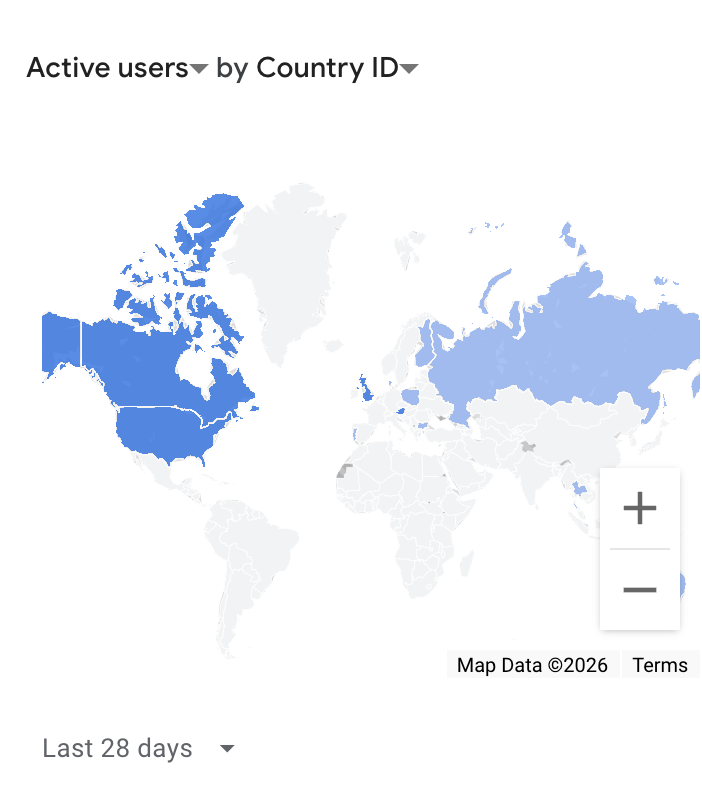
    I recently launched Loud Camel, a tool that helps researchers get cited and recognized. I opened the Google Analytics geographic report and got the “before” map below.

    The worst way to visualize geographic data

    Look at it for five seconds. Cover the title. What are the top five countries by active users?

    You probably said the United States. Maybe Canada and Russia. The blue blobs are big and obvious.

    Now find Israel.

    You can’t. It is one or two pixels somewhere east of the Mediterranean. Israel is currently the country with the most active users on the site. It is the leader. The map hides the leader.

    Why country maps mislead about counts

    A choropleth fills each country with a color whose intensity encodes a value. In theory the reader compares colors. In practice the reader compares areas, because area is the loudest visual signal on the page.

    A country with a huge area and a low value looks important. A country with a tiny area and a high value disappears. The reader’s eye correlates magnitude with land mass, not with the data.

    This works only when geographic proximity matters: epidemiology, regional logistics, climate maps. Visit counts have no spatial structure. A user in Texas is not “close” to a user in Mexico in any way that matters to the data. The map adds noise, not insight.

    Use a sorted bar chart instead

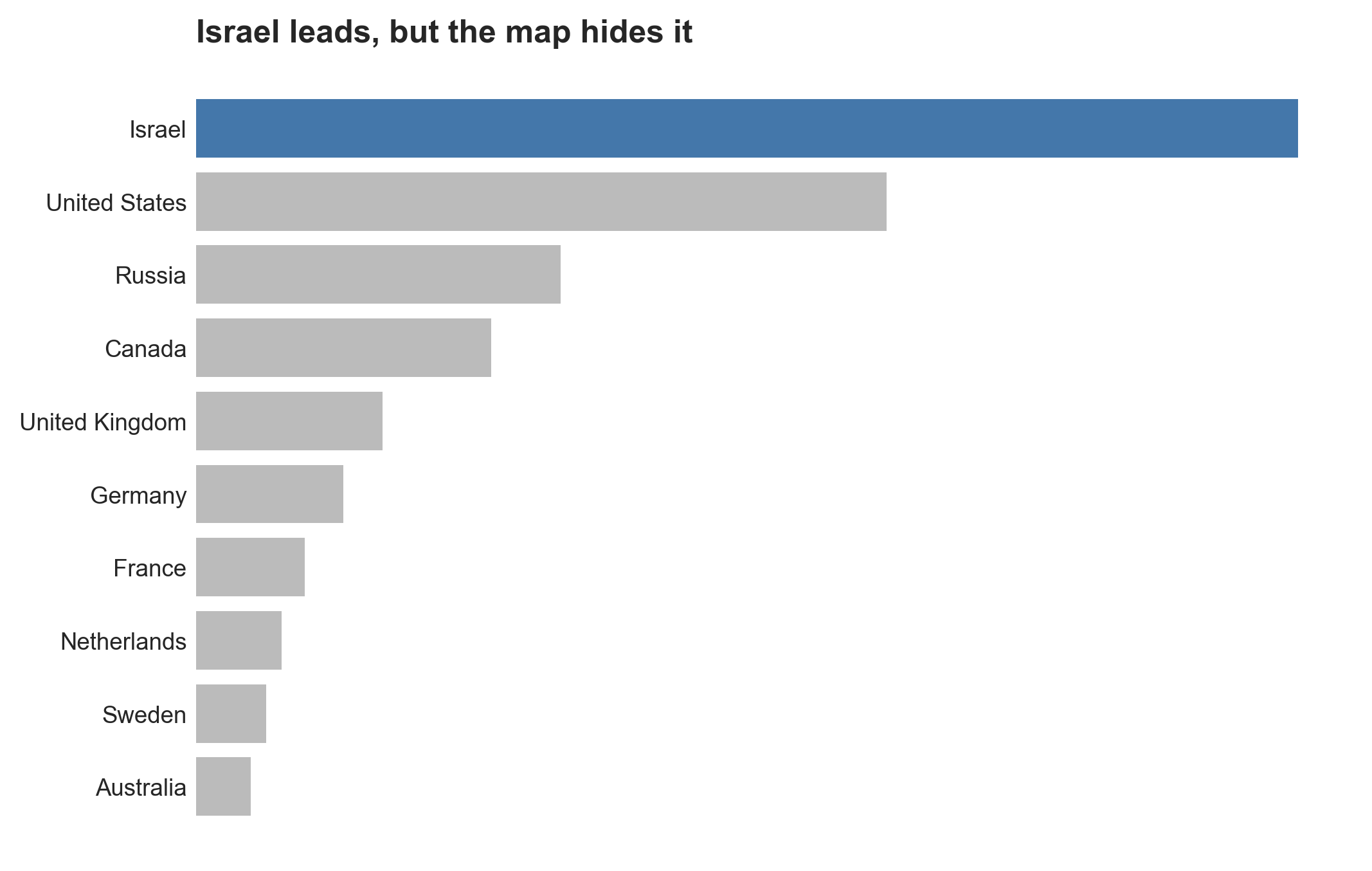
    The same data, sorted from largest to smallest as a horizontal bar chart, looks less sophisticated, but reads in one second.

    The worst way to visualize geographic data

    Bar length encodes the value directly. The reader’s eye runs top-down by magnitude. Israel is at the top because Israel has the most users. The United States is second because it has the second-most. There is nothing to interpret.

    The numbers in the chart are illustrative; the ordering is not.

    April 29, 2026 - 2 minute read -
    worst-practice Data Visualization datavisualization.md dataviz datavis charts.md analytics.md blog
  • The hardest part of being a solo founder wasn't what I thought

    The hardest part of being a solo founder wasn't what I thought

    April 28, 2026

    The hardest part of being a solo founder wasn’t what I thought

    The hardest part of running a one-person company is not the workload. It is choosing the right work.

    The hardest part of being a solo founder wasn't what I thought

    What I expected

    When I started, I assumed the hard part would be wearing every hat. CEO. CTO. CMO. VP Product. Four jobs in one chair, no one to delegate to, no one to escalate to.

    All of that while working full time as a lecturer and researcher at a college.

    The workload is real. It is not the bottleneck.

    What is actually hard

    A solo founder is one person, and that person has a default mode. Mine is building. I want to ship features, fix bugs, and tighten infrastructure until it hums.

    Building feels productive. It is measurable. It is satisfying. At the end of a coding day the diff is real, the bug list is shorter, the system is leaner.

    The work that pays the bills feels like distraction

    Sales conversations. Watching the market. Learning what customers actually need. Talking to people instead of typing into a terminal.

    This work has no diff at the end of the day. No ticket closed, no graph that moves on a dashboard you control. It feels soft, slow, like you are getting away with something.

    It is also the work that decides whether the product survives.

    The real lesson

    A perfectly built product nobody wants is worse than a half-built one customers are pulling out of your hands.

    The hardest part of being solo was not doing everything. It was resisting the role I am best at when another role needed me more.

    Building is the comfortable seat. Talking to customers is the uncomfortable one. The discipline is to spend more time in the uncomfortable seat than feels natural.

    A small weekly check

    Each Friday I ask one question: did I spend more time this week with code or with customers?

    If the answer is always code, that is the bug to fix.

    April 28, 2026 - 2 minute read -
    solo-founder.md focus.md product.md blog
  • When rigid blocs break, they break together

    When rigid blocs break, they break together

    April 25, 2026

    When rigid blocs break, they break together

    A rigid voting bloc is supposed to be the boring case. People vote the same way, election after election, because their identity tells them to. The interesting story, the textbook says, is what happens when the bloc weakens.

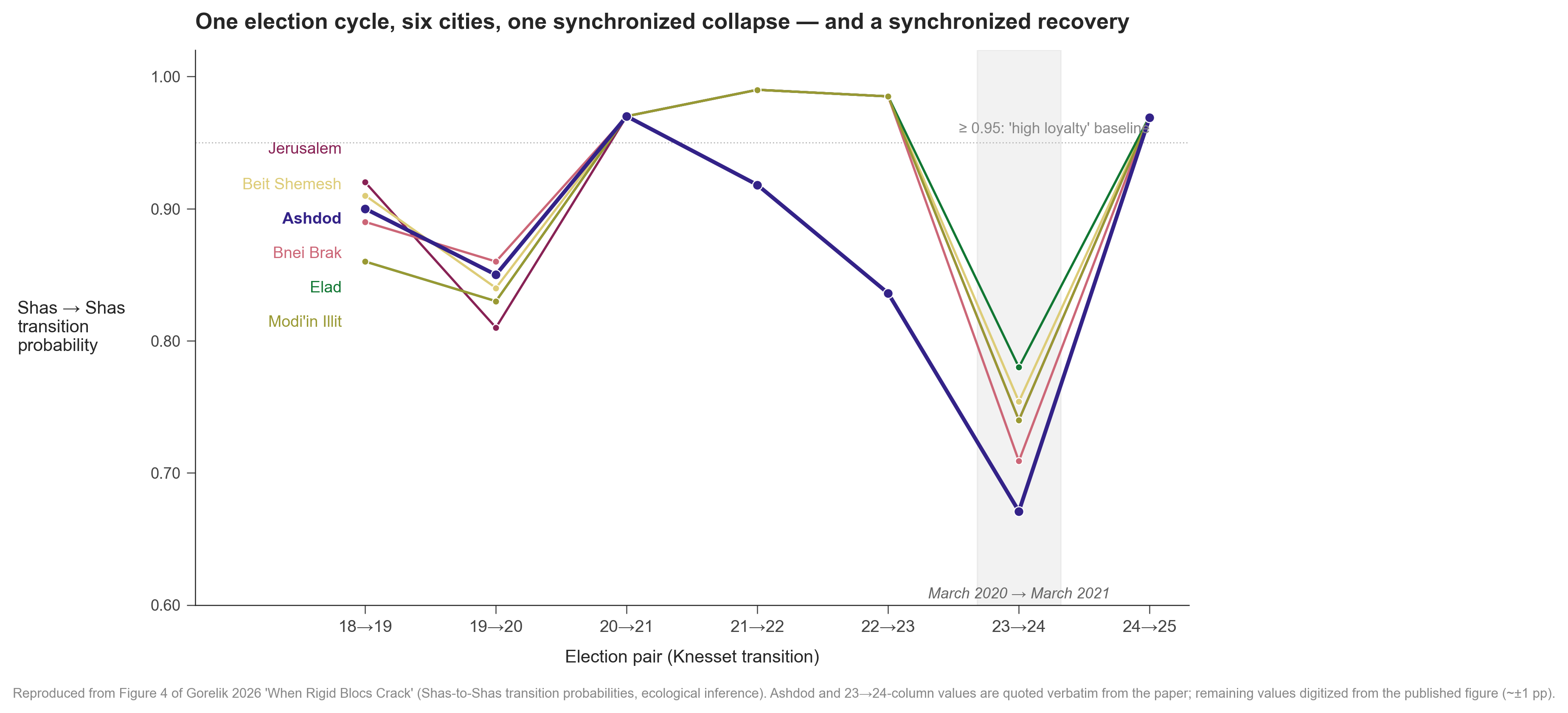
    I want to argue the opposite. The interesting case is when a rigid bloc breaks — and it breaks at every address at once. That synchronized fracture is not the bloc weakening. It is the bloc working.

    The puzzle

    Israel’s ultra-Orthodox (Haredi) population is one of the most disciplined voting blocs in any democracy. Two parties — UTJ for Ashkenazi voters, Shas for Sephardi voters — have split that vote with 90-95% loyalty for decades. Cross-ethnic voting (a Sephardi voting UTJ, or an Ashkenazi voting Shas) is so rare it is treated as measurement noise.

    Then, in the March 2021 election, that noise jumped to 12-19% of Sephardi voters in five different cities, all at once. By the next election it was gone again. The voters did not move house. The borders did not shift. Same people, same streets, one election of mass cross-ethnic switching, then back to baseline.

    The chart

    When rigid blocs break, they break together

    Cross-ethnic switching jumped from a typical 1-3% to 9-19% across geographically dispersed Haredi cities — within a single election cycle. Demographics cannot move that fast. Something else did.

    Why this matters

    There is a tempting reading: the bloc was finally weakening. Identity politics fading. Voters acting as individuals.

    That reading is wrong, and the geography is what tells you so. Independent voters do not switch in five cities in the same election in the same direction. Independent voters do not return to their original party 13 months later. What you see in the chart is coordination, not autonomy.

    The corpus evidence — about 58,000 Haredi forum and news items from those 13 months — points to a specific channel: senior rabbis, working through yeshiva networks, told Sephardi voters to vote UTJ that one cycle. They listened. When the directive softened, they returned.

    The framework

    I call this ‘rigidity with stress fractures.’ The same machinery that produces decades of unbroken loyalty — centralized authority, dense networks, voting framed as collective duty — is the machinery that produces an instant, country-wide swing when leaders ask for one. Rigidity and synchronized switching are not opposites. They are two outputs of the same system.

    This generalizes. Any identity-based bloc with centralized authority, organizational reach, and a population trained to follow directives can do this. Italian Christian Democracy under bishop replacements (Lanzara et al., 2024). U.S. evangelical voter guides (Campbell et al., 2011). Ethnic broker networks across sub-Saharan Africa (Horowitz, 1985). The Haredi case is unusually clean because elections came every 6-12 months and let us watch the disruption and the recovery in the same window.

    The takeaway

    When you see a sudden swing inside a population that was supposed to be politically immobile, do not jump to ‘the bloc is fragmenting.’ Check first whether the swing is synchronized — same direction, same magnitude, multiple places, single window. If it is, you are not watching the bloc weaken. You are watching it obey.

    The mechanism that holds the bloc together is the same one that can move it. Stability and discipline-driven volatility are not opposite diagnoses. They are the same diagnosis read at different speeds.

    April 25, 2026 - 3 minute read -
    politics elections.md sociology.md identity.md research Israel blog
  • The Arab leadership in 1948: mistakes, opportunities, and consequences

    The Arab leadership in 1948: mistakes, opportunities, and consequences

    April 22, 2026

    AI generated this summary from the Hebrew recording. No human has checked it, and it may contain errors. The recording is the authoritative source.

    In this episode, Boris Gorelik speaks with historian Prof. Benny Morris, a professor emeritus at Ben-Gurion University. The conversation provides a historical analysis of the decisions made by the Arab leadership in Palestine in the late 1940s, examines whether they had better alternatives, and discusses the consequences of those decisions on the Israeli-Palestinian conflict to this day.

    Read the full episode summary

    The Arabs’ opening position in 1947

    According to Prof. Benny Morris, the Arabs of Palestine entered the 1947-48 conflict with a clear demographic advantage, outnumbering the Jews two to one, and enjoyed potential support from the Arab and Muslim world. They felt self-confident. However, they did not recognize and did not want to recognize the Jewish claims to the land, and Jewish history or the Holocaust did not interest them. As early as the late 19th century, Prof. Morris explains, Arab intellectuals warned that Zionism aimed to take over the land and displace the Arabs. This fear, combined with the lack of recognition of Jewish aspirations, led them to believe that Arab and Muslim power would prevent the establishment of a Jewish state.

    The development of Palestinian identity

    Boris asks when the Arabs of the land began to see themselves as a separate Palestinian people. Prof. Morris believes the process began in the 1920s. According to him, it was a byproduct of geopolitical changes: the British conquest of the land and its separation from Greater Syria, which fell under French rule. The Arabs in the land understood that their political future was tied to the British and the Zionist challenge, not to what was happening in Damascus. From that moment, they began to think of themselves less as “Southern Syrians” and more as Palestinians. He emphasizes that most of the population was not political, but this national consciousness finally crystallized around 1948.

    The choice of war

    Prof. Morris explains that the war did not begin with a central order from the Mufti, Hajj Amin al-Husseini, but rather spontaneously, with local violent incidents that escalated into a civil war. The Arab leadership faced three options: accept the UN partition plan, accept Jewish rule, or go to war. They chose war. According to him, given their state of mind at the time, they probably could not have chosen differently. Their mindset was not built for compromise with the Jews.

    The advantages of the Yishuv

    The Jewish side, in contrast, enjoyed several crucial advantages. The Yishuv had succeeded in establishing a “state within a state” with functioning institutions. Additionally, it had great economic superiority, which was strengthened during the war by extensive donations from American Jewry. These funds enabled the purchase of weapons and the continuation of civilian functions. The Arab armies, except for the well-trained Jordanian Legion, lacked the resources, equipment, or training for a war beyond their borders. They were primarily designed to protect the regimes at home.

    After the 1948 war

    The defeat in the war left the Arab world with a sense of humiliation and a desire for revenge. At the same time, they recognized that Israel was strong. Prof. Morris notes that the establishment of the Jewish state also created a geographical disconnect between the eastern and western parts of the Arab world, which greatly bothered them. The “Three Nos” resolution at the 1967 Khartoum Summit was an expression of this humiliation, but according to him, this stance did not last long. After the 1973 war, which was perceived in the Arab world as an achievement, it was psychologically easier for leaders like Anwar Sadat to accept Israel’s existence and turn to peace.

    Prospects for peace and the pessimistic future

    Prof. Morris is pessimistic about the future. He argues that a true regional peace is not possible without a solution to the Palestinian problem, meaning the establishment of an independent Palestinian state. He believes this is a necessary, though not necessarily sufficient, condition for ending the conflict. According to him, Israel has rarely offered such a solution over the years, and even when it did (during the Barak and Olmert eras), the Palestinians refused. He adds another pessimistic layer: Jewish society in Israel is becoming more religious and right-wing, and support for the two-state solution is eroding. Meanwhile, Palestinian terrorism and rejectionism on the Arab side reinforce this trend. Without peace with the Palestinians, he warns, the existence of the State of Israel will ultimately be endangered.


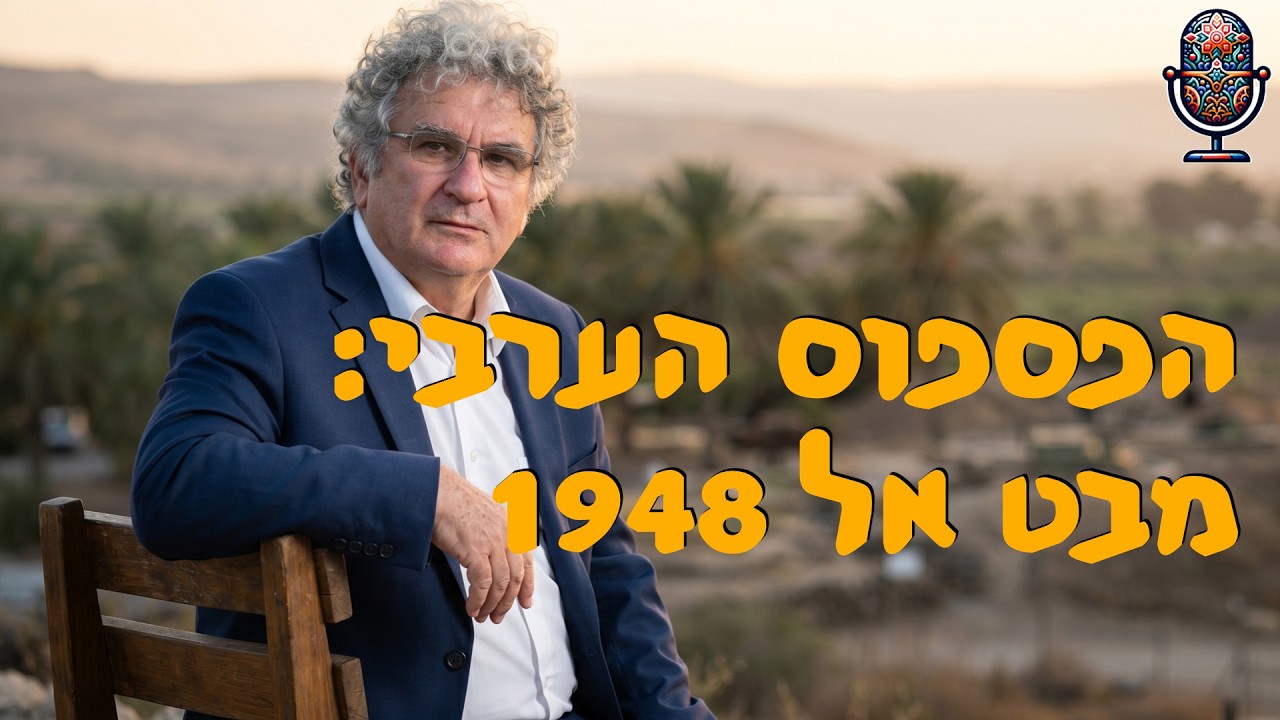
    The original episode, in Hebrew: הפספוס הערבי: מבט אל 1948

    April 22, 2026 - 4 minute read -
    podcast Middle East blog This Week in the Middle East
  • Sudan in the global conflict

    Sudan in the global conflict

    April 16, 2026

    AI generated this summary from the Hebrew recording. No human has checked it, and it may contain errors. The recording is the authoritative source.

    In this episode, Dr. Haim Koren, a diplomat and Middle East scholar, returns for a conversation about the civil war in Sudan. The conversation covers the causes of the war, the extensive international involvement in the conflict, and its implications for the regional and global balance of power, including for Israel.

    Read the full episode summary

    The civil war in Sudan

    According to Dr. Koren, since April 15, 2023, a war has been raging in Sudan between the two generals who have led the country since the 2019 coup: the de facto president, Abdel Fattah al-Burhan, and his former deputy, Mohamed Hamdan Dagalo, known as Hemedti. Hemedti, who was Burhan’s partner in the coup and also in signing the Abraham Accords, launched a rebellion to seize power. The war has already claimed hundreds of thousands of lives, created millions of refugees, and led to severe famine and massacres defined as genocide. The country’s economic situation is on the verge of collapse.

    International involvement: Who supports whom

    Dr. Koren explains that each of the warring sides has enlisted international support. General Burhan, the incumbent president, is supported by Egypt, Saudi Arabia, and Pakistan. In contrast, the rebel Hemedti is backed by the United Arab Emirates.

    A turning point occurred in October 2023, when Burhan, after Israel and other countries refused to supply him with weapons, turned to Iran for help. He justified this by saying he would take weapons even from the devil. Iran supplied him with UAVs and other weapons, which led to military successes for his forces.

    The Iranian involvement caused a shift in Russia’s position. Russia, which initially supported Hemedti (who had provided it with financial aid at the start of the invasion of Ukraine), switched sides and began supporting Burhan. Thus, Burhan now enjoys a broad coalition of supporters that includes Egypt, Saudi Arabia, Pakistan, and Russia.

    Regional rivalries: Saudi Arabia, the UAE, and Qatar

    The conflict in Sudan, according to Dr. Koren, is also an arena for regional power struggles. Qatar, which supports Burhan, is running a media campaign against the United Arab Emirates, partly through cartoons and fake news on the Al Jazeera network. In one cartoon, for example, Israel was depicted as a puppeteer controlling the UAE, thereby being falsely accused of complicity in the genocide in Sudan.

    Dr. Koren notes that there is also a rivalry between Saudi Arabia and the UAE, which was previously evident in the war in Yemen. However, recent Iranian aggression has caused them to reduce their disagreements and focus on the common threat.

    Sudan as a gateway to Africa

    Dr. Koren emphasizes Sudan’s strategic importance as a gateway to the Sahel region, a strip of 11 countries crossing Africa. Russia, through the Wagner Group, has used its foothold in Sudan to expand its influence into countries like Chad and Niger, while ousting traditional French influence through a series of military coups.

    This takeover is part of an effort by an axis that includes Russia, China, North Korea, and Iran. Iran, for example, has a clear interest in reaching Niger, one of the world’s largest uranium producers.

    The implications for Israel

    Sudan’s rapprochement with Iran represents a reversal of the trend of recent years, which included disengaging from the axis of terror and joining the Abraham Accords. Dr. Koren warns that one of the conditions for lifting sanctions on Sudan was combating terrorist elements, chief among them the Muslim Brotherhood. Now, there are reports of Muslim Brotherhood members returning to Burhan’s army. This combination, along with support from Iran and Pakistan, could turn Sudan back into a state sponsor of terrorism.

    According to him, the situation in Sudan cannot be resolved separately from the broader regional conflict. As long as the international picture, particularly the confrontation between Iran and the West, does not become clearer, no significant change is expected in Sudan.

    Support from Israel’s friends in Africa

    At the end of the conversation, Boris asks about the pro-Israel statements of a senior official in the Ugandan army. Dr. Koren explains this in the context of the widespread Christian Evangelical faith in Africa. Many Christian communities in Uganda, Kenya, and Ethiopia believe in the Bible and the Jewish people’s right to the Land of Israel. This support also stems from the common struggle against radical Islam, which threatens Christians in Africa. Therefore, when Iran threatens Israel, these voices rally to its defense, sometimes in creative ways.


    The original episode, in Hebrew: סודאן בלב הסערה

    April 16, 2026 - 4 minute read -
    podcast Middle East blog This Week in the Middle East
  • Syria after Assad: Israel's next enemy?

    Syria after Assad: Israel's next enemy?

    April 9, 2026

    AI generated this summary from the Hebrew recording. No human has checked it, and it may contain errors. The recording is the authoritative source.

    In this episode of “This Week in the Middle East,” Dr. Yaron Friedman analyzes the rise of the new regime in Syria, led by Ahmed al-Shara, known as al-Julani, and argues that Syria is rapidly becoming the next major threat to Israel. According to him, while Israel and the world are focused on the war against the Iranian axis, an equally dangerous jihadist enemy is forming beneath the surface on its northern border.

    Read the full episode summary

    A historical pattern of changing enemies

    Dr. Friedman begins by explaining a historical pattern in which the elimination of one enemy leads to the emergence of a new one. He provides several examples: the 1979 peace treaty with Egypt, which marked the decline of the “Sunni axis,” occurred concurrently with the Islamic Revolution in Iran, which created a new enemy. In Lebanon, the expulsion of the PLO led to the rise of Amal and Hezbollah. In the Palestinian arena, the Oslo Accords with Fatah led to the strengthening of Hamas and Islamic Jihad. Now, he asks, who will rise after Iran and Hezbollah are weakened in the current war.

    Syria under Julani: A new old threat

    In Dr. Friedman’s view, the answer is Syria under the leadership of Ahmed al-Shara (al-Julani). He describes Julani as a veteran, multifaceted terrorist, a former senior al-Qaeda figure, who is merely changing his form to gain international legitimacy. Friedman rejects the notion that Julani has moderated, pointing to the growing jihadist atmosphere in Syria, extremist educational content, and demonstrations at Damascus University reminiscent of ISIS.

    To understand the roots of the current regime, Friedman goes back to the Syrian civil war that broke out in 2011. The revolution began as a popular uprising of citizens demanding change, and a moderate, secular opposition even emerged. However, according to him, Islamist elements, led by Julani, who was then the leader of Jabhat al-Nusra, “stole the revolution.” Julani was sent to Syria by the leader of al-Qaeda to exploit the chaos and establish a jihadist force. The ideological difference between him and ISIS was small, but Julani adopted a more pragmatic tactic of cooperating with other organizations. In every area his forces conquered, he violently deposed the local committees and established committees that imposed Sharia law.

    The anti-Israeli radicalization in the new Syria

    Dr. Friedman notes that the proposed Israeli law to impose the death penalty on terrorists sparked an unprecedented wave of demonstrations in Syria. The protesters chanted distinctly anti-Jewish slogans, such as “Khaybar, Khaybar, ya Yahud,” and calls for the liberation of al-Aqsa. The demonstrations spread throughout the country, from Damascus to Aleppo, which, he claims, indicates direction from the regime. Julani, he says, could have stopped the protests but chose not to.

    Friedman wonders why the Syrians are not expressing gratitude to Israel for weakening their common enemies, the Assad regime and the Shiite axis. He recalls that Israel even provided humanitarian aid to wounded Syrians, including jihadists, as part of the “Good Neighbor” project. However, he also presents the Syrian perspective, which includes complaints about the Israeli presence in the Golan, the IDF’s takeover of the UN buffer zone after the fall of Assad, and the harm to local farmers. Additionally, there is a perception that Israel supports the Druze and encourages the breakup of Syria into cantons.

    The “Syrian solution” to the Hezbollah problem

    The discussion moves to the Lebanese front and the question of how to defeat Hezbollah. Since Israel does not want to enter Beirut and the Lebanese army is incapable of doing so, a dangerous idea arises: allowing Julani’s army to enter Lebanon and eliminate Hezbollah, his bitter enemy from the civil war. According to Friedman, there are suspicions of cooperation between Julani and elements in Lebanon, and he might receive international legitimacy for such a move.

    But Friedman warns that this is a catastrophic scenario. Iran and the Shiite militias in Iraq have already threatened to invade Syria if such a move occurs. It is more likely that Julani will wait for Israel to exhaust Hezbollah, and only then will he seize the opportunity to take over not just Damascus but also Beirut. The result would be the expansion of a hostile jihadist regime’s rule to the Mediterranean Sea, a move that would fulfill the vision of “Greater Syria” and pose a far more severe threat than a weakened Hezbollah.

    No magic solutions

    The host, Boris Gorelik, asks about alternatives, such as the rise of the Amal movement in place of Hezbollah or the establishment of a Druze-Christian buffer state. Dr. Friedman is pessimistic. He argues that decades of brainwashing by Hezbollah have created a deep-seated hatred that is difficult to uproot, similar to the extremist education now provided by the Syrian regime. As for a Druze state, he explains that the Druze would not agree to rule over Shiite areas in southern Lebanon to gain access to the sea. In conclusion, he notes that the only optimistic point at the moment is the United States joining the war against the Iranian axis, and he expresses hope that an era of agreements will follow the wars.


    The original episode, in Hebrew: האויב הבא

    April 9, 2026 - 4 minute read -
    podcast Middle East blog This Week in the Middle East
  • Turkey and the conflict with Iran: Between interests and a regional power

    Turkey and the conflict with Iran: Between interests and a regional power

    April 2, 2026

    AI generated this summary from the Hebrew recording. No human has checked it, and it may contain errors. The recording is the authoritative source.

    The episode features Dr. Tzamarat Levy-Daphny, a researcher from the Deborah Forum and Forum 1325, for a conversation about Turkey’s foreign policy. The conversation covers Ankara’s position on the conflict between Israel and Iran, its complex relations with Tehran, and its role as a regional power trying to navigate between conflicting alliances and interests. At the beginning of the conversation, Dr. Levy-Daphny explains that Forum 1325, of which she is a member, works to include women in political negotiation processes, in accordance with UN Security Council Resolution 1325.

    Read the full episode summary

    Turkey’s position on the conflict with Iran

    According to Dr. Levy-Daphny, Turkey is not silent about the war, and the issue receives extensive coverage in the Turkish press. However, in Israel, the discourse on Turkey tends to be superficial. Turkey issued a stern warning to Iran after Iranian missiles fired at Israel were intercepted in its airspace by NATO batteries. Iran, for its part, denied that the missiles were fired from its territory toward Turkey.

    Despite the incident, Turkey is not interested in a military escalation with Iran. According to Dr. Levy-Daphny, this has been a consistent policy for the last 20 years. The two countries have disagreements and conflicts in various arenas, such as Syria and Nagorno-Karabakh, but they operate mechanisms to contain the conflicts to prevent a direct military confrontation. Turkey has more to lose than to gain from such a confrontation. Therefore, despite its criticism of the Iranian attacks, Turkey will not join a military effort against Iran alongside the United States.

    Pragmatic foreign policy

    Boris asks if Turkey aspires to be not only a diplomatic power but also a military player, and how this aligns with its desire to avoid confrontations. Dr. Levy-Daphny explains that Turkish foreign policy is pragmatic and multi-layered. There are arenas where Turkey uses military force, such as in Syria, Libya, and Nagorno-Karabakh, and arenas where it refrains from doing so, as in the case of Iran.

    Turkey’s membership in NATO is a key factor. The alliance restricts Turkey, which cannot side with Iran, but it also provides it with protection, as demonstrated by the NATO air defense batteries stationed on its territory. Turkey sees itself as an important part of the alliance and is not considering leaving it, despite past tensions, such as those surrounding the purchase of the Russian defense system.

    In northern Syria, for example, Turkey has maintained military bases since the beginning of the civil war to protect its long border, mainly in the Kurdish context. It remains a significant military, political, and diplomatic force in Syria.

    Turkey, Azerbaijan, and Iran

    In the war between Azerbaijan and Armenia, Turkey provided significant military assistance to Azerbaijan, including drones. The bond between the two countries is deep and goes beyond military support. It is based on identity, cultural, and linguistic proximity, under the slogan “two states, one nation.” This bond began to strengthen after the dissolution of the Soviet Union.

    Boris notes Israel’s strong ties with Azerbaijan and asks why Iran refrains from attacking it, despite claims that Israeli aircraft might take off from its territory to attack Iran. Dr. Levy-Daphny notes that this is an interesting question and explains that the Iranian attacks were mainly aimed at targets identified with the United States.

    The fear of a refugee crisis

    One of Turkey’s biggest fears regarding an escalation with Iran is a stream of refugees. The border between the countries is long and difficult to fully secure. Turkey is still dealing with the economic and political consequences of absorbing over three million refugees from Syria, a crisis that has caused severe social tensions. Despite the aid it received from Europe, absorbing the refugees was a heavy burden. Therefore, Turkey is working to prevent a similar flow of refugees from Iran.

    Economic relations and the future of the Iranian regime

    Sanctions on Iran have harmed trade between it and Turkey, and its volume stands at only about three percent of total Turkish trade. However, trade has not ceased and includes strategic components like gas: 13% of Turkey’s gas consumption comes from Iran.

    According to Dr. Levy-Daphny, Turkey’s interest is the fall of the ayatollahs’ regime. A different regime in Iran, one that is more open to the West, would allow Turkey to realize the immense economic potential inherent in the relations between the two countries. She emphasizes that Turkey and Iran should not be compared. Despite the problems in the Turkish regime, it is a country that operates completely differently from Iran and does not try to export its state model in the same ways.

    Turkey as a regional mediator

    In Turkey, there is strong anti-Israeli public opinion, directed mainly at the policies of the current leadership. The prevailing perception is that Israel is dragging the region into a dangerous escalation. Accordingly, Turkey opposes the war and offers itself as a mediator. Dr. Levy-Daphny explains that Turkey sees itself as a player that can talk to all sides, and it does indeed pass messages between the Americans and the Iranians. This role is not new, and Turkey has served as a mediator in the past, for example in negotiations between Israel and Syria during the Olmert era.


    The original episode, in Hebrew: טורקיה והמלחמה עם איראן

    April 2, 2026 - 4 minute read -
    podcast Middle East blog This Week in the Middle East
  • Eliminating the regime in Iran, not overthrowing it

    Eliminating the regime in Iran, not overthrowing it

    March 27, 2026

    AI generated this summary from the Hebrew recording. No human has checked it, and it may contain errors. The recording is the authoritative source.

    In this episode, the guest is Middle East scholar and Iran expert Alex Grinberg. The conversation deals with the campaign against Iran, the future of the Islamic regime, and the question of who will declare the end of the war. Grinberg argues that the regime is not expected to fall officially, but rather to be gradually eliminated, and that Iran is expected to remain a unified country even on the day after.

    Read the full episode summary

    Methodology: Understanding Iran

    According to Alex Grinberg, the media narrative of the regime’s imminent fall is a misrepresentation. He emphasizes that no official, neither in Israel nor in the United States, has set the overthrow of the regime as a war objective. The stated goal is to remove the existential threat, and in the process, create conditions that will allow the Iranian people to act.

    Grinberg adds that a necessary condition for understanding Iranian society and politics is knowledge of the Persian language. He compares this to a physicist, who cannot practice their field without knowing mathematics. He claims that assessments of Iranian society by experts who do not speak Persian are worthless.

    Eliminating the regime, not overthrowing it

    Boris Gorelik asks if the Iranian threat can be removed without overthrowing the regime, and who is expected to sign a surrender. Grinberg replies that one should not expect a formal surrender or a white flag, as happened with Nazi Germany, nor an orderly transfer of power like in Spain after Franco or in the Soviet Union. According to him, military and political terms are not mathematical formulas, but are context-dependent.

    He distinguishes between “overthrowing a regime” and “eliminating a regime.” While the regime will not be officially overthrown, it will be eliminated in practice. The strategic threat, such as the ballistic missiles, has already been largely removed, and the IDF continues to hunt the few remaining launchers.

    The Iranian regime as a mafia organization

    To explain the logic behind eliminating the regime, Grinberg compares its conduct to that of a mafia organization. According to him, the mafia has several rules of conduct:

    1. It does not plan for the long term and does not prepare an alternative plan. Presenting a plan B is seen as a challenge to the leadership.
    2. All its members are partners in crime and mutually responsible for one another. They have nowhere to run, so they fight to the end.
    3. It goes for broke, and ultimately loses.

    This comparison explains why the regime will not surrender, but also why it is expected to crumble under sustained pressure.

    Damaging the regime’s capabilities

    Grinberg describes how military activity systematically damages the regime’s capabilities for control and oppression. He notes that air force strikes focus, among other things, on stadiums used as assembly areas for the Basij and the Revolutionary Guards. Hitting these places prevents them from organizing and disperses their forces.

    Additionally, he points to a phenomenon of Basij and Revolutionary Guards personnel being eliminated by small drones. Since these are short-range tools, the conclusion is that the operators are inside Iran. This indicates extensive cooperation by Iranian citizens with the attacking forces, including providing real-time coordinates of targets.

    Will Iran break apart?

    Boris Gorelik asks if Iran might break apart into separate ethnic states, as some commentators claim. Grinberg firmly rejects this possibility. He explains that most ethnic minorities in Iran, such as the Azeris, Kurds, and Baloch, see themselves first and foremost as Iranians. He gives the example of the Iran-Iraq War, in which the Arabs of Khuzestan province fought for Iran against Saddam Hussein’s army, and the Shiites in Iraq fought for their country against Iran.

    Furthermore, neighboring countries have no interest in Iran’s breakup. Azerbaijan, for example, would not want to absorb tens of millions of Azeris from Iran, and Iraqi Kurdistan would not support the establishment of another Kurdish state.

    The inability to recover

    In conclusion, Grinberg argues that the Iranian regime has suffered severe blows from which it cannot recover. It has lost the support of the Arab world and Russia, it lacks the necessary resources, and it has no legitimacy or cooperation from the population. In this situation, it will not be able to restore its nuclear program or its military capabilities. Iran might become an isolated ghost state like North Korea, but it will no longer pose a strategic threat.

    A question from the audience: Broadcasting impact maps

    In response to a listener’s question, Grinberg recounts an incident in a television studio where he protested the display of maps of launches from Iran alongside maps of impact sites in Israel. He claims that broadcasting such information constitutes aiding the enemy, as it allows them to improve their missile accuracy. He clarifies that he did not attribute malicious intent to the presenters, but pointed out a dangerous practice that should be avoided.


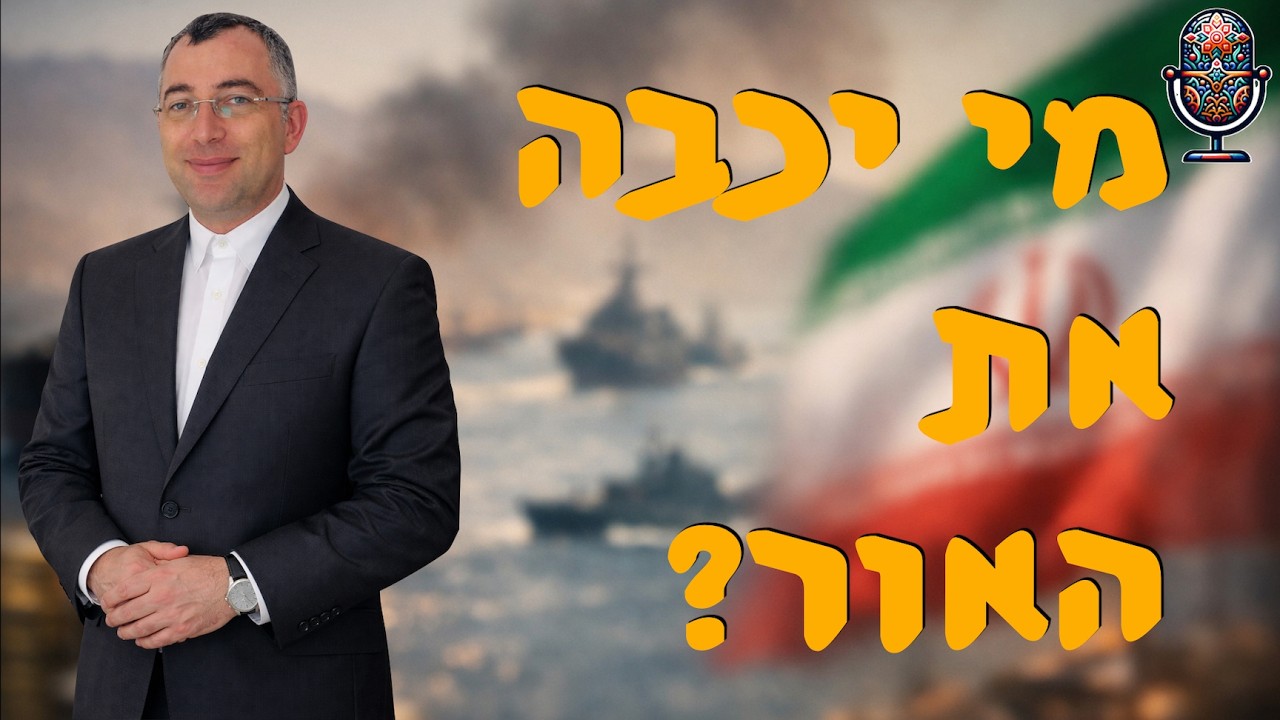
    The original episode, in Hebrew: מי יכבה את האור?

    March 27, 2026 - 4 minute read -
    podcast Middle East blog This Week in the Middle East
  • The failure of the Gulf concept: Qatar and the Gulf states at war

    The failure of the Gulf concept: Qatar and the Gulf states at war

    March 25, 2026

    AI generated this summary from the Hebrew recording. No human has checked it, and it may contain errors. The recording is the authoritative source.

    The episode features Dr. Ariel Admoni, a Qatar expert and a researcher at the Jerusalem Institute for Strategy and Security. The conversation deals with what Dr. Admoni calls the “failure of the Gulf concept.” According to him, the recent war revealed that there is no unified Gulf bloc, and that the foreign and security policy of each country, especially Qatar, was tested in a way that undermined basic assumptions about the region’s stability.

    Read the full episode summary

    No unified Gulf response

    According to Dr. Admoni, one of the common misconceptions is the existence of a unified “Gulf response” to crises. In reality, the recent war highlighted that each Gulf state acted according to its own narrow interests, sometimes in opposition to its neighbors. For example, Oman took an anti-American and anti-Israeli line, while the United Arab Emirates leaned more in their direction. Qatar, as usual, tried to maneuver in the middle and not commit to either side. The division was also reflected in the level of physical damage: while hotels were hit in the UAE and a port was hit in Oman, Qatar suffered almost no damage until the attack on the gas facilities in Ras Laffan.

    Leaders’ reactions and damage to image

    The division was also evident in the conduct of the leaders. The rulers of Bahrain and the United Arab Emirates conducted public tours to project a sense of security to the public. In contrast, Saudi Crown Prince Mohammed bin Salman and Qatari Emir Tamim bin Hamad made few public appearances, likely out of concern for their personal safety. Dr. Admoni notes that the Qatari emir avoided appearing at open-air events, and the absence of a pan-Gulf leaders’ meeting or even a coordinated statement highlighted the lack of unity and solidarity.

    The Gulf “hub” concept in danger

    One of the most significant impacts of the war, argues Dr. Admoni, is on the concept that the Gulf states, and Qatar in particular, have cultivated for decades: their image as a safe and stable international hub for business, finance, education, and tourism. The departure of foreign workers, the evacuation of citizens by embassies, and recommendations for foreign students to leave universities in Qatar all undermine the image of a “safe place.” According to him, the damage to energy facilities is only part of the harm. The main damage is to the concept of an open and immune Gulf, whose vast wealth is supposed to guarantee its security.

    Qatar’s hedging policy under pressure

    Qatar’s traditional hedging policy, in which it maintains ties with all sides simultaneously, came under severe distress during the war. On the one hand, Qatar tried to empower its security forces and present itself as having protected the American base on its territory. On the other hand, it used the first minor hit on its facilities to announce the shutdown of QatarEnergy, a move that caused global gas prices to jump by more than 50%. Dr. Admoni adds that Qatar began to take draconian internal measures, such as arresting hundreds of people and restricting social networks, which indicates a significant crack in its sense of security.

    Why a “Gulf NATO” is not feasible

    In response to a question from Boris Gorelik about whether the war might actually lead to a unification of Gulf forces, Dr. Admoni dismisses the possibility. He mentions the proposal by former Qatari Prime Minister Hamad bin Jassim to establish a “Gulf NATO,” but argues it is not feasible due to the deep rivalries between the countries regarding political Islam, Turkey, and Iran. As an example, he points to the distinctly pro-Iranian line of the Al Jazeera network, which even raised eyebrows in Qatar itself and anger in the other Gulf states. The proxy struggles between Qatar and the UAE, for example in Sudan and Somalia, continued even during the war and demonstrated the inability to create a united front.

    Listeners’ questions

    At the end of the episode, Dr. Admoni answers listeners’ questions. Regarding the connection with the Taliban, he explains that Qatar will not be quick to give up its asset of mediating with the organization, as it strengthens its position in the Sunni-Islamist axis. However, the connection is intended for communication, not for wielding power against Iran.

    Regarding education in the Gulf, he clarifies that there is a big difference between the countries. While the UAE and Saudi Arabia have changed their curricula, in Qatar there is still anti-Israeli and even antisemitic content in the humanities.

    Regarding Israel-Qatar relations, Dr. Admoni warns against a return to the pattern of covert cooperation under the logic of “the enemy of my enemy is my friend.” However, he believes that the current toxic public atmosphere, both in Israel and in Qatar, makes such a move more difficult than in the past.


    The original episode, in Hebrew: כשלון הקונספט המפרצי

    March 25, 2026 - 4 minute read -
    podcast Middle East blog This Week in the Middle East
  • Hardened as Fuck

    Hardened as Fuck

    March 25, 2026

    When in some places work meetings start with people introducing their preferable pronouns, in Israel we start with a briefing about the closest bomb shelter. When in other places people skip important meetings to take care of their pet goats (true story), in Israel people join meetings on Zoom from Army Reserve Service during breaks from patrols or other duties.

    I wrote about this last June. The war will end, I said, and when it does, hundreds of thousands of Israelis will come back – to work, to building, to a country in crisis. And crisis breeds resilience. They’ll come back hardened as fuck.

    Nine months later, nothing has changed my mind. If anything, I’m more convinced. The people who learned to operate under rockets, who managed companies while covering for half the team on reserve duty, who wrote code between sirens – they are coming back with muscles that can’t be trained in peacetime. Extreme communication, chaos management, creative problem-solving under constraints that most people can’t imagine.

    Good luck competing with them. Good luck competing with us.

    March 25, 2026 - 1 minute read -
    Israel leadership blog
  • AI adoption vastly lags its capability: a better graph

    AI adoption vastly lags its capability: a better graph

    March 25, 2026

    After my previous post about Anthropic’s spider chart, several people asked me how I would actually go about fixing it. So here is how – with a single prompt.

    I gave Claude the original graph and the following instruction, based on my C for Conclusion approach:

    the visualization is not good. First, formalize the image into a single-sentence conclusion of up to 8 words.

    Then, use the approach of Stephen Few and Edward Tufte, maximize the data-ink ratio, use Information layers (Jean-luc Doumont) to generate the graph based on the same data that is much better and that conveys the conclusion you made above

    That’s it. Here is the before and after:

    Before and after: Anthropic's spider chart vs. a clean dot plot

    The conclusion – “AI adoption vastly lags its theoretical capability” – is now the title. Categories are sorted, the gap is immediately visible, and there is nothing left to decode.

    See the standalone version of the graph (the raw data, as extracted by Claude, is in that file).

    For more on why radar charts are almost always a bad choice, see my earlier posts on spider charts and radar charts.

    But, Boris, vibe plotting is not a real expertise!

    Sure, but Anthropic people have access to the same vibe plotting tool I have (even better). It’s knowing what to ask for that is the real expertise. And if you don’t have that, you can always ask someone who does.

    March 25, 2026 - 2 minute read -
    Data Visualization before-after spider-chart radar-chart blog
  • Lecture and workshop proposals

    Lecture and workshop proposals

    March 23, 2026

    I have put together a collection of lecture, workshop, and course proposals on AI and AI-assisted programming. Each one is tailored to a specific audience and comes in three delivery formats: a one-hour lecture, a three-hour hands-on workshop, and a multi-session course.

    The topics range from a non-technical introduction to AI (for students from any department) to hands-on AI-assisted programming for CS students, CS lecturers, industrial engineering students, managers, and life science researchers. Most proposals are available in both English and Hebrew.

    All proposals are now collected on a single Lecture & Workshop Proposals page.

    March 23, 2026 - 1 minute read -
    teaching workshops blog
  • How do wars end?

    How do wars end?

    March 19, 2026

    AI generated this summary from the Hebrew recording. No human has checked it, and it may contain errors. The recording is the authoritative source.

    In this episode, the guest is Omer Dank, a security researcher, to discuss the question of how wars come to an end. The conversation reviews the various ways wars have ended in the modern era, and examines the possible scenarios for the end of the current (hypothetical) war between the United States and Israel and Iran.

    Read the full episode summary

    Seven ways to end a war

    According to Omer Dank, since the 19th century, seven main ways of ending wars between nation-states have taken shape.

    1. Surrender: One side announces its total surrender, as Japan did at the end of World War II. Dank emphasizes that he is dealing with ending wars, not ending conflicts, since surrender does not always bring an end to the conflict, as the resistance movement in France showed after its surrender to Germany.
    2. Conquest: One state conquers another, usually with the goal of imposing a new regime and then withdrawing. In the modern era, conquest for the purpose of territorial annexation has become rare. Examples include China’s conquest of Tibet or the American invasion of Iraq.
    3. Ceasefire: This is the most common way to end wars since World War II. A ceasefire can be the result of an agreement, but it is sometimes achieved without a formal agreement. Negotiations can take place before, during, or after the ceasefire, as was the case between Israel and Egypt after the Yom Kippur War. Those negotiations led to the 1978 peace treaty.
    4. External coercion: World powers, usually through the UN Security Council, impose a ceasefire on the warring parties. Most of Israel’s wars have ended this way.
    5. Unilateral withdrawal: A state that has invaded foreign territory decides to withdraw on its own initiative. Examples include China’s withdrawal from Vietnam in 1979 and Israel’s withdrawal from the Gaza Strip after Operation Cast Lead in 2009.
    6. Fading out: The war gradually subsides and the violence drops below the threshold defined as war, without a formal ending event. Dank presents the Second Intifada as a prominent example of this phenomenon.

    Dank is careful not to determine which way is preferable to another for ensuring long-term peace. He notes that conquest and the installation of an alternative regime, as in Iran in 1953, can provide temporary quiet, but can also sow the seeds of the next conflict.

    The issue of legitimacy

    Boris raises the question of the legitimacy of the party that decides to end the war. For example, after World War I, it was argued in Germany that whoever signed the surrender agreement was not authorized to do so. Dank argues that legitimacy is a subjective concept, in the eye of the beholder, and is related to the national narrative a nation tells itself. Legitimacy is indeed a factor of internal and external pressure on decision-makers, but it cannot be measured objectively.

    Scenarios for ending the war in Iran

    Dank analyzes the possible scenarios for ending the current war with Iran. He rules out the possibility of external coercion, because it is impossible to force a superpower like the United States to end a war through the UN due to its veto power.

    A scenario of aerial bombings that would cause the Iranian people to overthrow the regime seems unlikely to Dank. He explains that there is no historical precedent for such a situation. Heavy bombing of Germany and Japan in World War II did not cause a popular uprising. In addition, Iran is not a one-man dictatorship but is controlled by a broad elite of the Revolutionary Guards, which enjoys a considerable base of support. Therefore, overthrowing the regime is more complex than ousting a single dictator.

    Another obstacle to an agreement is what Dank calls the commitment dilemma. The Iranian regime has no reason to believe that the current American administration will abide by any agreement, given past experience. Therefore, the chance that Iran would agree to surrender in exchange for a promise that the regime will continue to exist is slim. Such a surrender would only be possible if Iran reaches a state where it completely loses the ability to hurt its rivals, a process that could take a long time.

    Internal chaos or a ceasefire?

    In conclusion, Dank outlines three main possibilities for ending the war:

    1. A mediated ceasefire: This is the most likely scenario in his view. Such an agreement, reached through the mediation of a third country (like Oman or Qatar), would allow both sides to present some achievement and save face, even if it does not resolve the tensions in the region.
    2. Iranian surrender: A possible scenario only after a long and exhausting war that depletes Iran of its military and economic capabilities.
    3. Internal chaos in Iran: The war could lead to the outbreak of mass protests, as have occurred in the past, which would lead to the collapse of the regime and a period of uncertainty about Iran’s future.

    The original episode, in Hebrew: איך מסתיימות מלחמות

    March 19, 2026 - 4 minute read -
    podcast Middle East blog This Week in the Middle East
  • The economic war against Iran and its allies

    The economic war against Iran and its allies

    March 12, 2026

    AI generated this summary from the Hebrew recording. No human has checked it, and it may contain errors. The recording is the authoritative source.

    In this episode, Dr. Yaron Friedman joins the show to discuss the economic war being waged in parallel with the military conflict with Iran. The conversation focuses on the consequences of a blockade of the Strait of Hormuz for the economies of Iran, the Gulf states, Iraq, and other regional actors, and examines who the main losers and winners are from the situation.

    Read the full episode summary

    The blockade of the Strait of Hormuz and partial solutions

    According to Yaron Friedman, a blockade of the Strait of Hormuz is a move that would paralyze 20 percent of the global oil market as well as all gas exports from Qatar. Despite this, oil prices are not crossing the $100 per barrel mark. Friedman explains this by noting that two countries, Saudi Arabia and the United Arab Emirates, prepared in advance for such a possibility. Saudi Arabia laid a 1,200-kilometer oil pipeline, the Abqaiq-Yanbu line, which transports oil from the Persian Gulf to the Red Sea. From there, the oil is transported north to Egypt in another pipeline, and from there to the Mediterranean Sea. The United Arab Emirates built a shorter pipeline from Abu Dhabi to Fujairah, which bypasses the Strait of Hormuz overland. Friedman notes that the Saudi pipeline can transport about 80 percent of Saudi oil, and the Emirati one about 60 percent of Emirati oil. These solutions, although partial, alleviate the situation.

    The biggest losers from the blockade

    Friedman details which countries are most affected by the situation. The first loser is Iran itself. All of its oil exports are sea-based and pass through the Strait of Hormuz, mainly via Kharg Island. An attack on this island, as happened in the Iran-Iraq War, or an American takeover of it, could completely paralyze Iran’s economy. The second biggest loser is Iraq. Its economy relies on oil for 90 percent of its revenue, and 99 percent of its exports pass through Hormuz. Unlike the Gulf states, Iraq has no plans to diversify its economy, and it is almost completely paralyzed. A northern pipeline to Turkey and overland transport through Jordan solve only a few percent of the problem. In addition, the pro-Iranian militias in Iraq, which receive government funding, are also suffering from a cash shortage. Other countries that are severely affected are Kuwait and Qatar, which have no alternative export solutions. Friedman notes that the impact on Qatar also indirectly affects Hamas, which benefits from Qatari funding, especially as Iranian funding for Islamic Jihad has stopped.

    The economic blow to Hezbollah

    Hezbollah is suffering a severe economic blow from several directions. According to Friedman, Iran, which is under attack, cannot send it funds. The Syrian border is closed, Venezuela is no longer a source of funding, and airports are not a safe channel for transferring suitcases of dollars. In addition, enforcement campaigns against drug trafficking in Syria and Lebanon are hitting another source of the organization’s income. To all this is added internal pressure from the Shiite community, which demands the reconstruction of villages destroyed in the war, as well as pressure from the families of the “martyrs.” Recently, Friedman explains, buildings belonging to the Al-Qard al-Hasan bank, which is used for money laundering and financing Hezbollah, were also bombed. He quotes Naim Qassem, Nasrallah’s deputy, who complained in a speech about the bombing of the bank “that helps the poor and needy.”

    Other effects on the region and the world

    Friedman notes that China, which bought 90 percent of Iranian oil at rock-bottom prices, is severely affected by the situation, although it has alternatives like Russia. Other Asian countries that bought Iranian oil while bypassing sanctions are also in distress. Turkey fears a wave of refugees from Iran and has suffered attacks near the Ceyhan oil terminal, which also receives oil from Azerbaijan destined for Israel. In contrast, Europe and the United States are less affected. The United States has large oil reserves, and Europe has alternatives like oil and gas from Algeria and Norway. According to Friedman, Iran’s only way to end the war is to create economic and strategic pressure on the Gulf states, even at the cost of burning all ties with them.

    The position of the Gulf states and the chance of a decisive outcome

    In the Arab media, Friedman explains, there are dual messages. The Gulf states cannot express open support for Israel, but they are interested in the war continuing in order to weaken Iran. Even Qatar, which was a close ally of Iran, was attacked, proving that no one is immune. Friedman believes that economic warfare alone cannot decide a campaign or topple regimes. However, it can erode them from within and weaken them. If the war ends with Iran’s coffers empty, it will accelerate the loosening of the ayatollahs’ rule and the weakening of Hezbollah. He mentions the fall of the Soviet Union as an example of a superpower that collapsed partly due to economic pressure. Finally, he estimates that a military decision would require a ground operation that reaches Tehran, the center of Iranian power.


    The original episode, in Hebrew: המלחמה הכלכלית של איראן

    March 12, 2026 - 4 minute read -
    podcast Middle East blog This Week in the Middle East
  • Anthropic: great research, not-so-great graph

    Anthropic: great research, not-so-great graph

    March 7, 2026

    Anthropic has published an interesting study about labor market impacts of AI: Labor market impacts of AI: A new measure and early evidence.

    It is hard to overestimate Anthropic’s contribution to the world of technology. Their innovation and professionalism are remarkable. But sadly, in the report they included a spider graph that leaves their entire post with a bad taste. (I wrote about spider charts many times before.)

    It takes a good minute or two to understand what the image is about. Spider charts are almost always a bad data visualization technique. So how do we fix it?

    First, we need to define the conclusion. A short sentence of up to 8 words that conveys the general idea of the graph. After that, we create a graph that does exactly that – conveys the conclusion.

    Here, the conclusion is the difference between theoretical AI capability and the observed AI adoption across occupational categories. So we need to show exactly that difference.

    Look at the improved graph. All the categories are sorted according to the observed adoption rate. The differences are immediately visible, and the conclusion is right at the top of the graph, leaving no room for guessing.

    Before and after: Anthropic's spider chart vs. a sorted bar chart

    March 7, 2026 - 1 minute read -
    worst-practice Data Visualization before-after spider-chart radar-chart blog
  • Iran's fake Battle of Karbala

    Iran's fake Battle of Karbala

    March 3, 2026

    AI generated this summary from the Hebrew recording. No human has checked it, and it may contain errors. The recording is the authoritative source.

    This episode’s guest is Dr. Yaron Friedman from the Department of Middle Eastern Studies at the University of Haifa. The conversation deals with Iran’s parade of strategic mistakes, which Dr. Friedman likens to a modern, but fake, Battle of Karbala. According to him, this is a pre-lost war that the Iranian leadership entered after believing its own propaganda.

    Read the full episode summary

    The modern Battle of Karbala

    According to Dr. Friedman, Naim Qassem, Hassan Nasrallah’s deputy, predicted a war in the style of the Battle of Karbala, and the prophecy was fulfilled. The original Battle of Karbala, in 680 AD, was a pre-lost war waged by Hussein ibn Ali, the grandson of the Prophet Muhammad, against the corrupt Umayyad dynasty. He went into battle out of a sense of justice, even though he knew he would lose. Khomeini, during the 1979 Islamic Revolution, presented this battle as a model of sacrifice and inspiration for future generations, and thus justified the Iran-Iraq War. However, Friedman argues, the current war is a “fake Karbala.” This is not a just struggle, but the result of 40 years of Iranian propaganda, which the leaders began to believe to the point of launching a suicidal war.

    Revenge on the Sunni world

    Friedman explains that Iran’s attacks on the Gulf states stem from a desire for revenge. In the long term, this is historical Shiite revenge on the Sunni world for centuries of oppression. In the short term, it is revenge on the Gulf states for supporting Saddam Hussein in the Iran-Iraq War, for hosting American bases, and for normalizing their relations with Israel. He points to 1979 as a turning point: while Iran became an enemy of Israel and the US, Egypt, the leader of the Sunni world, signed a peace treaty with Israel. These opposing trends fueled Iranian anger.

    Iran’s parade of folly

    Dr. Friedman lists a series of grave mistakes made by the Iranian leadership. First, it ignored the deep intelligence penetration by the Mossad and the CIA into its ranks, which allowed for the easy elimination of its top command. Second, it did not take the threats of US President Donald Trump seriously, even though he eliminated Qasem Soleimani in 2020. The Iranians thought they could stall for time in negotiations, while the Americans were preparing for war. Another mistake was carrying out the threat to attack its neighbors in the Gulf. The move, intended to pressure the US, turned the entire Muslim world against Iran and gave leaders like Mohammed bin Salman an opportunity to lead an Arab coalition against it.

    Activating the militias

    The order Iran gave its militias to attack was, according to Friedman, another act of folly that was suicidal for them. Hezbollah, for example, gave Israel legitimacy to attack it forcefully and weaken it for “the day after” the Iranian regime’s collapse. Friedman explains that Hezbollah fears revenge will come from Syria and other actors after it loses Iranian support. The Shiite militias in Iraq are also now suffering American attacks, and they even fired missiles toward Israel that landed in Jordanian territory. As for the Houthis in Yemen, they remained out of the picture, likely due to their difficult economic situation. Meanwhile, the shared Iranian threat has led to a reconciliation between Saudi Arabia and the United Arab Emirates, and they are investing in Yemen’s reconstruction, a move expected to weaken the Houthis even further.

    Between a fake Karbala and moderate Shiite hope

    Friedman reiterates his claim that the war Iran is waging in the name of religion is a “fake Karbala,” managed by terrorists who cynically use religious concepts to accumulate power, similar to ISIS. In response to Boris’s question of whether the Iranian leadership believes itself, Friedman replies that it is possible, but notes that Supreme Leader Khamenei is not a true supreme religious authority. The real senior authority, Ayatollah Ali al-Sistani, who resides in Najaf, Iraq, calls for calm, introspection, and a focus on religion rather than wars. Friedman hopes that after the regime’s collapse, the moderate and quietist Shiite stream, known as “Taqiyya,” is what will prevail.

    Iran has no friends

    To conclude, Dr. Friedman states that Iran has no real allies. Russia and China have betrayed it. According to him, the Chinese exploited Iran economically and bought its oil and resources at rock-bottom prices, and the Russians received military aid from it in the form of UAVs for their war in Ukraine, but gave nothing in return.


    The original episode, in Hebrew: איראן מתאבדת

    March 3, 2026 - 4 minute read -
    podcast Middle East blog This Week in the Middle East
  • Consequences of the conflict with Iran: From the Strait of Hormuz to the global economy

    Consequences of the conflict with Iran: From the Strait of Hormuz to the global economy

    February 28, 2026

    AI generated this summary from the Hebrew recording. No human has checked it, and it may contain errors. The recording is the authoritative source.

    In this episode, recorded as the military campaign against Iran was unfolding, the guest is Eran Efrat, an expert in energy economics. The conversation revolves around the immediate economic consequences of the conflict, primarily the closure of the Strait of Hormuz, and examines the dramatic changes that could occur in the global economy the day after the fall of the ayatollahs’ regime.

    Read the full episode summary

    The closure of the Strait of Hormuz

    According to Eran Efrat, in the event of a military incident in the Persian Gulf, it does not matter who declares the Strait of Hormuz closed. Insurance companies will not allow ships to pass through the area, and traffic will effectively stop. He explains that most of Saudi Arabia’s oil production has no real alternative to passing through the strait, as the pipeline leading to the Red Sea has limited capacity.

    Blocking the strait, which he describes as the global shipping equivalent of the Ayalon Highway at 8 a.m., will cause severe delays in the global energy supply. The result will be an immediate rise in oil and gas prices. Efrat adds that if the Houthis join the campaign and also close the Bab el-Mandeb Strait, the world will face a severe trade crisis. Boris Gorelik notes that the immense economic pressure created could spur the United States to act for a swift end to the conflict.

    Iran’s regional isolation

    Efrat notes that the Iranian attack targeted almost all of its neighbors, including Qatar, its partner in the world’s largest gas field, as well as Saudi Arabia, Kuwait, Bahrain, and the Emirates. According to him, even if the regime survives the military attack, it will be very difficult for it to restore its standing. Iran depends on its neighbors for trade and assistance, and the attacks have created a geopolitical rift that will make it difficult for it to recover.

    The day after the regime’s fall

    Efrat, who says he has never known an Iran not under sanctions, describes the enormous economic potential inherent in the country. Iran has vast oil reserves, is second only to Russia in its gas reserves, and holds deposits of minerals and precious metals estimated to be worth a trillion dollars.

    However, he emphasizes that the country’s infrastructure, from the refining industry to production, is in a dilapidated state and will require huge investments to realize this potential. If the regime falls and sanctions are lifted, Iran will become a major energy player in the global market. Its entry will flood the market with supply and lead to a significant drop in prices.

    Who would oppose the change?

    According to Efrat, there are countries that would not be happy to see Iran freed from sanctions. Chief among them is China, whose small refineries, known as “teapots,” rely on buying discounted Iranian oil. If Iran starts trading on the open market, China will have to pay a higher price. Russia and Turkey also benefit from the current situation.

    However, Efrat does not believe that China will intervene militarily to prevent the regime’s fall. He explains that China has no history of military intervention far from its borders and tends to adapt to new realities. He gives the example of Venezuela, where China dramatically reduced its oil purchases after the United States began managing the sales.

    The country’s future and relations with Israel

    The conversation also touches on the fear of a power vacuum in Iran. Efrat expresses skepticism about the ability of the exiled crown prince, Reza Pahlavi, to lead the country, and raises the concern of a civil war.

    Despite this, he is optimistic about the future. According to him, a post-regime Iran could become a tremendous partner for Israel. He argues that in terms of human capital and capabilities, the Iranian people are perhaps the most similar to Israel in the Middle East. Efrat believes that a stable, Western-oriented Iran, similar to a well-managed Turkey, could be a positive engine of growth that would propel the entire region forward.


    The original episode, in Hebrew: ועכשיו? האם זה סופה של הרפובליקה האסלאמית?

    February 28, 2026 - 3 minute read -
    podcast Middle East blog This Week in the Middle East
  • Older posts Newer posts